Victims’ Rights Protection Trust
The legal process is fully active, funds are being secured into Court accounts, and distribution will follow lawfully and transparently.
🔍 Transparent Platform – No Secrets
This is the only platform that openly informs investors about every development – good or bad. Evidence collection, Government auction preparation, buyer coordination, and legal steps are all communicated directly. VRPT acts as the only genuine bridge between CCS, the Court, and investors.No hidden agenda, no secrecy, no backdoor settlements. Everything is coordinated openly with CCS and presented before the Hon’ble Court.
⚖️ High Court Status
There is virtually no chance for Kamalakar to secure a stay. CCS is executing actions professionally. Government auction amounts, bank balances, and ₹26 crores from Bengaluru will be deposited into the Court account, enabling structured distribution.🧾 Claims Process
Investors need to enter:• CCS Registration Number
• Membership Number
• Interest received
• Amount returned (if any)
System automatically generates the statement. Software settled up to 31 October 2025. Once Court orders, claims can be submitted with:
• Self Declaration
• System Statement
• CCS Receipt Copy
🚫 Disturbing Elements Exposed
A few individuals tried to mislead, bargain secretly, pretend representation and create confusion. Once confronted with facts, they collapsed under their own contradictions and became irrelevant. Kamalakar also tried multiple disguises and settlement tricks, but now he has trapped himself.🤝 Commitment
No personal gain, no investment, yet full responsibility was taken. VRPT was registered, impleaded in High Court and fought continuously despite criticism. Some had to be blocked or removed, yet the mission remained: clear enforceable orders for principal, interest and compensation.Email from CH S RAJAGOPAL
For Victims Rights Protection Forum & High Court Case Support
Date: Nov 22, 2025, 6:50 PM (20 hours ago)
To: me, dfivictimsforum | Attachments: Yes
High-End Legal Counter
Based on Dhanwantari Foundation International (DFI) Life Membership Letter
1. Introductory Submission: Your Lordship, the impugned Life Membership letter issued by Dhanwantari Foundation International (hereinafter “DFI”) is, in itself, a self-incriminating document. It exposes that DFI is not a simple charitable or spiritual body, but an organized, profit-oriented financial establishment which has been mobilising money from the public under the deceptive façade of “Life Membership” and “Brahmin community welfare,” in clear violation of the statutory regime governing deposits, investment schemes and financial establishments.
2. Nature and Scale of Operations Admitted: In this letter DFI proudly proclaims that it has more than 1,40,000 Life Members and that membership fees are being collected across multiple branches in Andhra Pradesh, Bengaluru, Mumbai and proposed branches in all District Headquarters and State Capitals. Such wide-spread, systematic and organised mobilisation of funds from the public is the hallmark of a financial establishment, not a small religious or charitable trust. The very scale of operations, as admitted by DFI, proves that vast sums of money have been collected from thousands of individuals under a common scheme.
3. Financial and Commercial Promises Amount to Deposit Schemes: The letter goes far beyond a mere invitation to join a trust. It expressly promises that Life Members will receive commercial, financial and service benefits – including discounts on goods and services, concessions from doctors and advocates, access to funeral packages, catering services, group health insurance, and other structured benefits. These inducements are directly tied to the payment of money to DFI. When funds are collected from the general public with such promises of financial and commercial advantage, the monies collected assume the character of “deposits” and the scheme falls squarely within the mischief of deposit-taking and unregulated financial activity.
4. Admission of Group Companies and Investment Opportunities: DFI openly admits that it is running and promoting a group of commercial companies – including DFI InfoTech, Dharani Sheltors, DFI Traders, DFI Viniyog, DFI Publications and DFI Therapeutics. The letter further assures Life Members that, in due course, these commercial companies will develop into multinational companies and that members will be given an opportunity to participate as investors and reap benefits in proportion to their investment. This is a direct invitation to invest in profit-making ventures under the umbrella of DFI, and constitutes an express admission that funds are being raised from the public with a view to deploy them in commercial enterprises for profit.
5. Profit-Sharing and “Fruits of Commercial Activities”: The letter repeatedly states that members will enjoy the “fruits of Commercial / Service activities being undertaken by DFI.” This language unmistakably reveals a profit-sharing mechanism. It is not a mere charitable distribution to beneficiaries, but a sharing of returns arising from commercial operations in consideration of amounts collected from members. Such an arrangement, emanating from an unregulated body that is neither a registered NBFC nor a SEBI-regulated collective investment scheme, is patently illegal and falls within the prohibition against unregulated deposit schemes.
6. Unique Identity Cards as Instruments of Inducement: The letter further admits that a DFI “Unique Identity Card” will be issued to Life Members, entitling them to discounted services from member-professionals and member-merchants and to goods at 20% less profit margin. The issuance of such cards, which operate as access passes to a bundle of financial and commercial advantages, is an additional inducement to enrol and pay money to DFI. The card is thus an instrument used to attract and retain depositors in an unregulated financial network, and is wholly inconsistent with the functioning of a genuine public charitable trust.
7. Use of Magazine and Communication Network to Promote the Scheme: DFI also confesses that it uses its monthly magazine “Dhanwantari Vani” as a medium to continuously communicate with its vast membership base and to disseminate information about DFI’s activities. This shows a well-planned marketing and communication infrastructure to promote the scheme, expand the member-base, and thereby increase the inflow of funds. A charitable trust does not need such aggressive promotion of “membership” and “benefits”; a financial establishment running a money-mobilising operation does.
8. Misuse of Trust Structure and Community Sentiment: The letter carefully wraps all these financial and commercial assurances in the language of “Brahmin community upliftment,” “protection of interests of Brahmins,” and “service to community and society.” By doing so, the accused have exploited religious and community sentiments to win the confidence of innocent members, especially elderly persons and middle-class families, and thereby induced them to part with their hard-earned money. This constitutes a serious breach of trust and an aggravated form of cheating, as the trust structure and community identity have been misused as instruments of fraud.
9. Incompatibility with the Defence of “Voluntary Contributions”: In the light of these clear and unequivocal admissions in the letter, the stand of the accused before this Hon’ble Court that they were only receiving voluntary contributions or nominal membership fees, without any promise of returns, is demonstrably false. The letter proves that DFI systematically offered financial, commercial and investment-linked advantages to members, thereby converting so-called “membership fees” into consideration for financial schemes. The defence of charitable intent is therefore illusory and unsustainable.
10. Consequences for the Present Proceedings: Once this Court accepts, on the basis of DFI’s own written communication, that the organisation has been mobilising public funds under a profit-oriented scheme and routing them through group commercial companies, the applicability of depositors-protection legislation and attachment proceedings becomes inescapable. The letter annihilates any alleged bona fides of the accused and establishes that the attachment of properties and continuation of criminal proceedings are not only justified but imperative in the larger public interest.
In these circumstances, this Life Membership letter, placed on record by the victim investors, stands as a crucial and self-contained piece of documentary evidence which conclusively demonstrates the fraudulent and illegal financial character of DFI. It completely erodes the foundation of the accused’s plea for any stay, suspension or dilution of the attachment orders, and powerfully supports the prayer of the victim investors for stringent prosecution and effective recovery of their monies through the process of law.
| PRAYER | |||
|---|---|---|---|
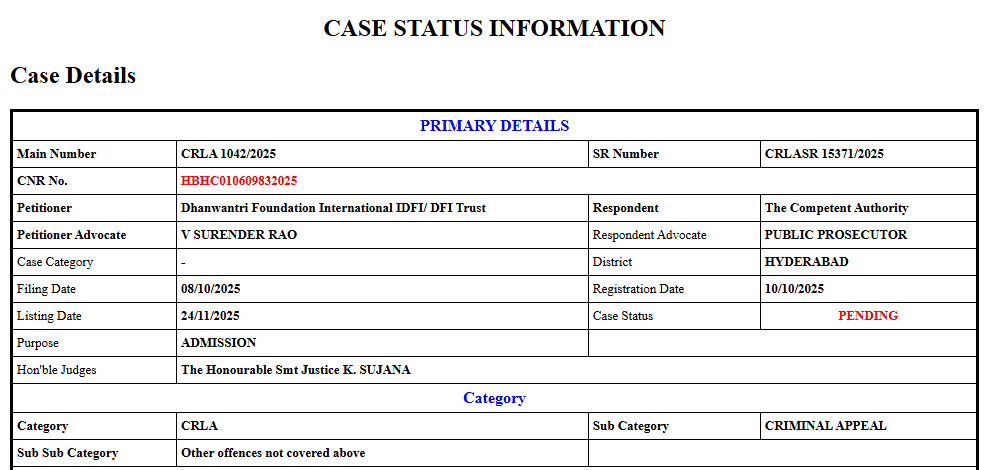
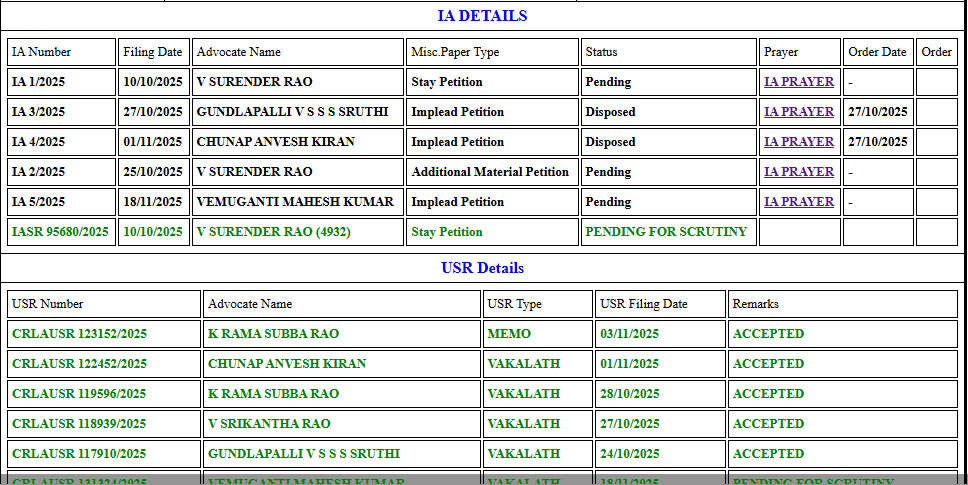
| The Memorandum of Grounds of Criminal Appeal is filed against the order dated 29/08/2025 made by the Sessions JudgecumSpecial Judge at Hyderabad under Section 7 of the Protection of Depositors of Financial Establishments Act 1999 whereunder the Special Judge made the interim attachment orders under G O Rt No 561 absolute The properties mentioned in the said GO relating to M/ s DPI Infra Projects Private Limited Appellant is filing this Memorandum of Grounds of Appeal on the following grounds Respondent No 1 is the applicant in the impugned order whereas the appellant herein is the first respondent and respondent No 2 to 7 are respondent No 2 to 7 |
CONNECTED MATTERS | |||||||||||||||||||||||||||||||||||||||||||||||||||||||||||||||||||||||||||||||||
| |||||||||||||||||||||||||||||||||||||||||||||||||||||||||||||||||||||||||||||||||
VAKALATH | |||||||||||||||||||||||||||||||||||||||||||||||||||||||||||||||||||||||||||||||||
| |||||||||||||||||||||||||||||||||||||||||||||||||||||||||||||||||||||||||||||||||
LOWER COURT DETAILS | |||||||||||||||||||||||||||||||||||||||||||||||||||||||||||||||||||||||||||||||||
The Memorandum of Grounds of Criminal Appeal is filed against the order dated 29/08/2025 made by the Sessions JudgecumSpecial Judge at Hyderabad under Section 7 of the Protection of Depositors of Financial Establishments Act 1999 whereunder the Special Judge made the interim attachment orders under G O Rt No 561 absolute The properties mentioned in the said GO relating to M/ s DPI Infra Projects Private Limited Appellant is filing this Memorandum of Grounds of Appeal on the following grounds Respondent No 1 is the applicant in the impugned order whereas the appellant herein is the first respondent and respondent No 2 to 7 are respondent No 2 to 7 | |||||||||||||||||||||||||||||||||||||||||||||||||||||||||||||||||||||||||||||||||
PRAYER | |||||||||||||||||||||||||||||||||||||||||||||||||||||||||||||||||||||||||||||||||
| |||||||||||||||||||||||||||||||||||||||||||||||||||||||||||||||||||||||||||||||||
IN THE HIGH COURT FOR THE STATE OF TELANGANA AT HYDERABAD
CRIMINAL APPEAL No. ______ OF 2025
… Appellant
… Respondents
I, Kalle Nagaraja Giriprasad, S/o K. Nagaraju, aged about 54 years, Occupation: Social Service, R/o H.No. 16-11-780/C, Moosarambagh, Dilsukhnagar, Hyderabad, C/o DFI Victims Forum, Victims Rights Protection Trust, Regd. No. 209/2025, Office at D.No. 3-4-1005/6, Dantuapally Chambers, 5th Floor, Barkatpura, Hyderabad, being the authorised representative of the victim investors, do hereby solemnly affirm and state as follows:
1. I am Respondent No. 8 in the above Criminal Appeal and am well acquainted with the facts of the case. I am authorised by the victim investors to file this Counter Affidavit on their behalf, and I am competent to depose to the facts stated herein.
2. The contents of the Appeal and the accompanying Stay Petition are false, misleading, evasive and devoid of bona fides. The Appellant has approached this Hon’ble Court with unclean hands, by suppressing material documents and mischaracterising the nature of the transactions and the status of the properties attached under the Telangana Protection of Depositors of Financial Establishments Act, 1999 (“Depositors Act”).
I. The Stay Petition Is a Mala Fide Dilatory Tactic
3. The present Stay Petition is nothing but a calculated and mala fide attempt to obstruct, delay and nullify the well-reasoned absolute attachment orders passed by the learned MSJ Court under the Depositors Act, after a detailed consideration of voluminous evidence relating to long-term financial fraud, misappropriation and illegal mobilisation of public deposits through Dhanwantari Foundation International (“DFI Trust”) and its frontal companies.
4. The learned MSJ Court has already recorded, on the basis of material placed by the Competent Authority (CCS), that the activities of the Appellant and the DFI group constitute a classic case of a fraudulent “financial establishment” operating under the deceptive cover of a charitable trust and a network of closely held companies.
5. The Appellant has failed to show any error apparent, perversity, jurisdictional defect, or violation of principles of natural justice in the attachment proceedings. The Stay Petition, therefore, is not an invocation of appellate jurisdiction in good faith, but an abuse of process intended solely to buy time, preserve illegally accumulated assets and defeat the legitimate claims of thousands of depositors.
II. Trust Deed Completely Prohibits Financial Schemes, Deposits & Real-Estate Ventures
6. The Trust Deed dated 22.04.2004, already forming part of the record, is the foundational document of Dhanwantari Foundation International (“DFI Trust”). It describes DFI Trust as a Public Charitable Trust established exclusively for:
- healthcare,
- education,
- medical relief,
- social welfare, and
- relief to the poor.
7. Nowhere in the Trust Deed is there any clause authorising:
- collection of deposits from the public,
- membership-linked land allotments,
- sale of plots or “agraharams”,
- collection of “development charges”,
- issuance of receipts or instruments promising returns,
- conduct of financial schemes or debenture-like products, or
- any commercial activity akin to a financial establishment.
8. On the contrary, the Trust Deed specifically stipulates that all funds can only be in the nature of donations, gifts, grants or contributions, that such funds shall accrue as Trust property, be deposited into Trust bank accounts, and be utilised strictly for charitable purposes, under collective control of the Board of Trustees and subject to mandatory maintenance of accounts and annual audit.
9. The Trust Deed further provides that no Trustee is authorised to borrow, lend, pledge or divert Trust monies for personal or commercial use, and that Trust properties belong to the Trust as an institution and not to any individual.
10. Thus, the Trust Deed itself exposes the falsity of the Appellant’s stand. Every act of public deposit collection, real-estate venturing, plot sale, “venture” promotion or interest-bearing scheme undertaken in the name of DFI Trust is ultra vires the Trust Deed, illegal in law, and amounts to misuse of a charitable platform to run a private, unregulated financial establishment.
11. The same Trust Deed, which the Appellant now seeks to rely upon for portraying himself as a “charitable trustee”, becomes the most incriminating document, because it conclusively shows that he has acted wholly outside and in breach of his own founding instrument.
III. Systematic Misuse of “DFI Trust” as a Fraudulent Financial Establishment
12. In practice, DFI Trust was projected to the public as a benevolent and spiritually oriented charitable body, especially targeting members of the Brahmin community and senior citizens. Under this façade, the Appellant:
- mobilised crores of rupees from the public,
- promised high returns and/or land allotments,
- issued receipts and documents in the nature of debentures or investment acknowledgments,
- induced depositors to part with their life savings, and
- failed to reflect such collections in any genuine Trust accounts.
13. The central instrument of deception was the so-called “DFI Super Speciality Hospital Project”, presented in Dhanwantari Vani (November 2023 issue and other publications) as a ₹150-crore hospital over about 2,420 sq. yards, with two cellars, multi-floor infrastructure and multiple advanced medical departments. These representations:
- prominently displayed the DFI Trust logo,
- mimicked the layout and appearance of official government or institutional publications, and
- were designed to create absolute faith that a large charitable medical project was under execution and that the investors’ money was safe and sacred.
14. No such hospital was ever built. No statutory approvals were obtained. No genuine construction or operational activity took place. Yet the Appellant relentlessly used these graphics, layouts and claims for years to secure deposits and “development charges” from elderly and vulnerable investors.
15. In stark contradiction, the Appellant simultaneously claimed, in communications with a private finance company, that the very same hospital property was a personal mortgaged asset of his wife, complaining that investigative agencies had wrongfully seized it and urging the lender to approach this Hon’ble Court. This irreconcilable stand—charitable trust project for investors on one hand, wife’s personal mortgaged asset on the other—constitutes clear, wilful fraud and deception.
16. The investigation by the Central Crime Station (CCS), acting as the Competent Authority under the Depositors Act, has already revealed extensive diversion of depositor funds into benami assets held in the names of the Appellant’s daughters, brother, relatives, household staff and close associates, and also into a dense web of companies floated and controlled by the same small group of directors.
17. The Appellant was under a statutory obligation to disclose all relevant properties and financial interests to the Competent Authority. Instead, he wilfully concealed several properties, obstructed the investigation and attempted to defeat the recovery rights of thousands of depositors.
IV. Minutes of Vijayawada Venture Meeting – Direct Admissions of Fraud
18. The Minutes of the Vijayawada Venture Meeting dated 11.02.2018, circulated by the Appellant’s own organisation, constitute a documentary admission of wrongdoing. They record inter alia that:
- money was accepted from 100+ members for a project where the required land had not yet been acquired;
- only about 19 acres were actually available whereas 8–9 more acres were “still required”;
- despite this, specific deadlines such as August 2018 and December 2018 were promised for registrations;
- excuses like demonetisation, cash crunch and “capital formation” were advanced to justify non-performance; and
- development charges of ₹700/– and ₹1,000/– per sq. yd. were collected without any CRDA approval or statutory sanction.
19. The Minutes further show that a religious figure was placed on the dais to give an aura of divine blessing and to emotionally manipulate investors into believing that the venture was holy, safe and guaranteed.
20. These Minutes, read with the receipts and subscription records, demonstrate that the Appellant collected money without owning the necessary land, made false promises of imminent registrations, and used religious sentiment as a tool of inducement. This is classic cheating and illegal mobilisation of deposits, not bona fide charity.
V. Publications in “Dhanwantari Vani” and Other Material – Pattern of Cheating
21. Over several years, the Appellant’s publication “Dhanwantari Vani” carried:
- imaginary hospital layouts and architectural drawings,
- exaggerated land bank and project descriptions,
- announcements of “mega hospital” and “agraharam” projects,
- timelines and promises that were never honoured, and
- extensive use of the DFI Trust logo and name to bolster credibility.
22. Not a single major project advertised in these magazines has been completed. Not a single investor has received the promised land or returns. Repeated requests for refund or performance were met with evasions, threats, insults, or directions to “wait for some more time”.
23. In many cases, the Appellant took original documents from investors, gave them signed photocopies, and assured that funds or debenture amounts would be repaid “shortly”, but no such repayment was ever made. These practices amount to dishonest inducement and criminal breach of trust.
VI. ROC Financial Statements – Zero Real Business, Only Diversion
24. The Consolidated Financial Statements of DFI Ventures Limited for 2021–22 (Form AOC-4 CFS filed with ROC) expose the underlying fraud. They reveal, inter alia:
- Zero Revenue from Operations – The company reports ₹0.00 operational revenue, indicating that no genuine construction, services, or land development was carried out despite the huge amounts collected from investors.
- Unsecured Long-Term Borrowings of about ₹56.36 Crores – This large figure is not explained as bank or institutional finance. It is nothing but investor money disguised as “borrowings”.
- Short-Term Loans & Advances of about ₹27.84 Crores – There are no transparent details of borrowers, security or purpose, indicating diversion and layering of investor funds.
- Cash Balance Collapsing from around ₹78 Lakhs to about ₹3 Lakhs – This shows that funds were siphoned out, without corresponding project expenditure or investor refunds.
- Negative Net Worth (approximately –₹1.63 Crores) – The company is balance-sheet insolvent, yet deposits from investors continued for years.
- No “Deposits” Declared (₹0.00 under deposits) – Although crores were collected from investors, the company falsely reports no deposits, indicating concealment and falsification under the Companies Act and corroborating offences under the Depositors Act.
25. Across the financial statements, there is a common pattern: no genuine income, no completed projects, no real assets for investors, only unexplained borrowings, dubious advances and vanishing cash. This aligns with Ponzi-style operations where new money is collected while old obligations remain unpaid.
VII. Cluster of 40+ DFI Companies – One Common Financial Establishment
26. The public records of the Ministry of Corporate Affairs show that Dr. Pantangi Kamalakar Sharma (DIN 00134889) has floated and controlled a dense web of more than forty companies, including but not limited to:
- DFI Ventures Ltd, DFI Infra Projects Pvt Ltd, DFI Nirmaan Pvt Ltd, DFI Traders & Distribution Co Pvt Ltd, DFI Vihar Pvt Ltd, DFI Upahar Pvt Ltd, DFI Srujana Pvt Ltd,
- Dhanwantari Bhavans Pvt Ltd, Dhanwantari Therapeutics Pvt Ltd, DFI Hospitals Pvt Ltd, DFI Health Care Services Pvt Ltd,
- DFI Publications Pvt Ltd, DFI Television Pvt Ltd, DFI Advertising Company Pvt Ltd,
- various “Avenues” companies (PKS, PSS, PJS, SRS, VSR Avenues Pvt Ltd) and other related entities.
27. In virtually all these entities, the Board is confined to the same small circle of individuals:
- Dr. P. Kamalakar Sharma (DIN 00134889),
- his wife Mrs. Jayasree Sarma Pantangi (DIN 00134991),
- Mr. Satya Sree Peesapati (DIN 02608613),
- Mr. Vennelaganti Subba Rao (DIN 01886689),
- Mrs. Anuradha Akella (DIN 07221829), and
- in some cases, Mrs. Padmaja Lakkaraju (DIN 07220283).
28. These companies were progressively incorporated between around 2001 and 2017, almost all from the same address at Raghavendra Hills, Mylardevpally, Hyderabad. They were used to mobilise and layer public funds in the guise of hospital projects, real-estate schemes, “ventures”, education and other activities.
29. When seen together with DFI Trust, the entire “DFI group” clearly operated as a single financial establishment under common control and common design, created and multiplied only to divert, park and disguise investors’ money, rather than to carry on any genuine independent business.
VIII. Massive Personal Enrichment of Appellant
30. It is a matter of record and public knowledge among the victims that the Appellant came to Hyderabad with almost no assets—famously described by investors as “coming with a single suitcase/cloth bag”—and today, after two decades of deposit mobilisation, he stands in control of properties and interests worth hundreds of crores of rupees.
31. This exponential, unexplained accumulation of wealth strictly correlates with the period of collection of deposits, diversion of trust funds, and operation of the DFI companies. Meanwhile, more than 4,120 identified victims—many of them senior citizens—have been reduced to financial ruin.
32. This glaring asymmetry between investors’ destitution and the Appellant’s personal opulence is itself a compelling indicator of fraudulent misappropriation and fully justifies the attachment orders passed by the MSJ Court.
IX. Post-Bail Misconduct & Continuing Influence
33. Even after being granted bail, the Appellant has:
- circulated misleading WhatsApp and other messages,
- continued to hold out false promises of imminent registrations and settlements,
- attempted to pressurise and influence victims, and
- sought to create confusion regarding CCS investigation and court proceedings.
34. Such conduct constitutes continued obstruction of justice, intimidation of victims and interference with the investigation, and completely extinguishes any claim to equitable or protective relief before this Hon’ble Court.
X. Legal Position Under the Depositors Act and General Law
35. The Depositors Act is a welfare-oriented social legislation enacted specifically to protect innocent citizens from fraudulent financial establishments masquerading under various labels such as “trusts”, “chit schemes”, “real estate ventures” or “development projects”.
36. The Act looks to the substance of the transaction rather than its nomenclature. Money collected from the public with a promise of return, benefit, land or other advantage, is a deposit, irrespective of whether it is described as “donation”, “advance”, “hospital development contribution” or otherwise.
37. The Hon’ble Supreme Court has recognised that offences undermining the financial security of large numbers of citizens amount to a form of “social terrorism”, and that statutes like the Depositors Act must be interpreted strictly against financial swindlers.
38. In pari materia legislation (such as in decisions like State v. K.S. Palanichamy and related cases), the Supreme Court has upheld the power of the State to provisionally and absolutely attach properties of financial establishments under Section 3 and allied provisions, holding that such measures are necessary to secure investor interests and prevent dissipation of assets.
39. In the present case:
- every rupee collected from investors is a protected deposit;
- DFI Trust and the cluster of DFI companies together constitute a financial establishment;
- G.O. Ms. No. 665 and connected Government Orders were issued after detailed material was placed by CCS and are not “mechanical”;
- the MSJ Court has already, upon due consideration, converted provisional attachments into absolute orders for the benefit of depositors.
40. The Appellant’s attempt to portray these deposits as “voluntary donations” or “charitable contributions” stands demolished by his own Trust Deed, receipts, Minutes, financial statements and conduct.
XI. No Grounds for Stay – Balance of Equity Favours Victims
41. For grant of any Stay, the Appellant must demonstrate:
- a strong prima facie case,
- irreparable loss if Stay is refused, and
- balance of convenience in his favour.
42. In the present case:
(a) No Prima Facie Case – The Trust Deed, Dhanwantari Vani publications, Vijayawada Minutes, ROC financials and CCS investigation together paint a consistent picture of long-term fraud.
(b) No Irreparable Loss – The properties attached are the very assets believed to be purchased or developed using investor funds. The only irreparable loss is to the victims, if assets are allowed to be alienated.
(c) No Balance of Convenience in Favour of Appellant – Convenience lies entirely with thousands of defrauded citizens whose funds must be secured immediately. The victims are largely senior citizens, widows, retirees, temple priests, teachers and small businessmen, many older in age than the Appellant himself. They have waited for over a decade. Any delay in execution will effectively deny them justice during their lifetimes.
43. On the other hand, granting Stay would:
- embolden the Appellant to attempt further alienation or layering of properties,
- frustrate the statutory purpose of the Depositors Act,
- undermine public confidence in the justice system, and
- reward a party whose hands are demonstrably unclean.
44. It is therefore respectfully submitted that no form of Stay whatsoever ought to be granted in favour of the Appellant in the facts and circumstances of this case.
XII. Need for Immediate Execution & Direction for Detailed Investor Statements
45. The absolute attachment orders passed by the learned MSJ Court are:
- reasoned and evidence-based,
- passed after hearing all sides, and
- necessary to secure the interests of thousands of victims.
46. Any delay in execution will expose the attached properties to risk of further encumbrances, benami transfers or dissipation, particularly when the Appellant is already shown to have created multiple layers of companies and benami holdings.
47. In addition to maintaining and executing the existing attachments, it is essential that this Hon’ble Court direct the Appellant and all DFI group entities to file comprehensive investor-wise statements, disclosing in respect of each victim:
- total amount collected,
- date-wise particulars,
- interest payable up to 31.10.2025, and
- proposed compensation for mental harassment, loss of peace, and prolonged deprivation of their life savings.
48. Such a direction will not only assist the Competent Authority in quantifying claims but will also expose the full magnitude of the fraud and prevent any further suppression or manipulation of records by the Appellant.
XIII. Summary of Core Position
49. In summary, the Respondents submit that:
- DFI Trust is, on paper, a purely charitable trust, and its Deed does not permit collection of deposits, financial schemes, returns, or real estate ventures.
- All monies collected from investors were illegal and ultra vires the Trust Deed, amounting to financial fraud under the Depositors Act and BNSS/IPC offences.
- The Chairman, Dr. P. Kamalakar Sharma, personally diverted investor funds through a network of closely held companies and benami entities, violating every core clause regarding accounts, meetings, audits and collective management.
- His arguments before this Hon’ble Court claiming charitable purpose and denying financial establishment activity are false, self-contradictory and demolished by his own documents.
- The deposits in question are protected assets, and the attachments and absolute orders passed by the MSJ Court are fully valid, lawful and necessary.
- The Trust Deed, the Vijayawada Minutes, Dhanwantari Vani publications, ROC filings and financial statements together establish a large-scale, meticulously engineered fraud perpetrated under the cover of a charitable institution.
Prayer
50. In the above facts and circumstances, it is most respectfully prayed that this Hon’ble Court may be pleased to:
- a. Dismiss the Criminal Appeal and the connected Stay Petition in limine as being devoid of merit and bona fides;
- b. Affirm and direct immediate execution of the absolute attachment orders passed by the learned MSJ Court under the Telangana Protection of Depositors of Financial Establishments Act, 1999;
- c. Direct the Appellant and all DFI group entities to file before the Competent Authority and this Hon’ble Court detailed investor-wise statements, indicating for each victim:
- total amount collected,
- date-wise particulars of receipts,
- interest calculated up to 31.10.2025, and
- proposed compensation for mental harassment, loss of peace of mind and prolonged deprivation of their savings;
- d. Record the admitted and established violations of the Trust Deed, the statutory provisions of the Depositors Act, the Companies Act and the penal law, as reflected in the Trust Deed, the Vijayawada Minutes, Dhanwantari Vani publications, ROC financial statements and investigation records; and
- e. Pass such other or further order(s) as this Hon’ble Court may deem fit and proper in the interests of justice, equity and protection of thousands of innocent depositors.
Place: Hyderabad
Date: ____ / ____ / 2025
Deponent
(Kalle Nagaraja Giriprasad)
Verification
I, Kalle Nagaraja Giriprasad, the above-named deponent, do hereby verify that the contents of paragraphs 1 to 50 of the above Counter Affidavit are true and correct to the best of my knowledge, information and belief, and nothing material has been concealed therefrom.
Verified at Hyderabad on this ___ day of __________, 2025.
Deponent
(Kalle Nagaraja Giriprasad)
KAMALAKARA SHARMA PANTANGI
KAMALAKARA SHARMA PANTANGI is a director registered with Ministry of Corporate Affairs. Their Director Identification Number (DIN) is 00134889. KAMALAKARA SHARMA PANTANGI is/has been associated with 46 companies.
Companies Associated With
Managing Director | 14-Mar-2009 | |
Director | 13-Oct-2020 | |
Director | 14-Mar-2008 | |
Director | 10-May-2001 | |
Managing Director | 08-Jan-2010 | |
Managing Director | 28-Jan-2010 | |
Director | 20-Dec-2011 | |
Managing Director | 18-Mar-2009 | |
Managing Director | 07-Jul-2008 | |
Managing Director | 19-Dec-2017 | |
Managing Director | 14-Mar-2009 | |
Managing Director | 19-Dec-2017 | |
Managing Director | 31-Dec-2008 | |
Managing Director | 03-Dec-2009 | |
Managing Director | 17-Apr-2009 | |
Managing Director | 24-Sep-2009 | |
Director | 10-Apr-2013 | |
Managing Director | 05-Jul-1994 | |
Managing Director | 11-Mar-2010 |
Past Companies Associated With
Director | 24-Mar-2008 | 14-Mar-2009 | |
Director | 17-Feb-2009 | 16-Mar-2009 | |
Managing Director | 16-Mar-2009 | 26-Mar-2015 | |
Director | 01-Sep-2009 | 28-Jan-2010 | |
Managing Director | 28-Jan-2010 | 26-Mar-2015 | |
Director | 01-Jan-2010 | 08-Jan-2010 | |
Director | 15-Jul-2009 | 18-Jul-2009 | |
Managing Director | 18-Jul-2009 | 26-Mar-2015 | |
Director | 16-Jul-2009 | 23-Jul-2009 | |
Managing Director | 23-Jul-2009 | 26-Mar-2015 | |
Director | 15-Jan-2010 | 28-Jan-2010 | |
Director | 17-Mar-2008 | 18-Mar-2009 | |
Director | 04-Feb-2009 | 05-Feb-2009 | |
Managing Director | 05-Feb-2009 | 26-Mar-2015 | |
Director | 18-Jul-2009 | 18-Jul-2009 | |
Managing Director | 18-Jul-2009 | 26-Mar-2015 | |
Director | 21-Jun-2008 | 07-Jul-2008 | |
Director | 10-Mar-2010 | 11-Mar-2010 | |
Managing Director | 11-Mar-2010 | 15-Jul-2021 | |
Director | 25-Feb-2010 | 11-Mar-2010 | |
Managing Director | 11-Mar-2010 | 15-Jul-2021 | |
Director | 20-Dec-2007 | 14-Mar-2009 | |
Director | 22-Dec-2008 | 31-Dec-2008 | |
Director | 01-Dec-2009 | 03-Dec-2009 | |
Director | 20-Mar-2009 | 17-Apr-2009 | |
Director | 05-May-2009 | 24-Sep-2009 | |
Director | 25-Feb-2010 | 11-Mar-2010 |
The present matter demonstrates a long-standing and deeply entrenched financial fraud orchestrated through the Dhanwantari Foundation International and an extensive network of companies directly controlled by the principal accused, Dr. Pantangi Kamalakar Sharma. Throughout today’s analysis, it stands conclusively established that no fewer than 46 commercial companies, many of them bearing the DFI prefix, were incorporated, managed, and operated under the sole command of the accused, revealing a financial architecture that cannot be separated from the Trust’s activities. These companies include DFI Publications, DFI Nirmaan, DFI Ventures, DFI Infra Projects, DFI Hospitals, DFI IT Solutions, DFI Infotech India, DFI Viniyog, DFI Health Care Services, Dharani Shelters, Sree Raghavendra Hospitals, and numerous Avenues companies, being inter-linked components of the same fraudulent mechanism.
Parallel to this, today’s discussion also establishes that Ms. Satya Sree Peesapati, another principal participant, is associated with 25 DFI-linked companies, serving as Director or Additional Director, thereby forming a second tier of the corporate web used for diversion, layering, and concealment of investor funds. Both individuals—Pantangi and Peesapati—have used their positions to create a multilayered commercial lattice capable of absorbing huge volumes of public money while evading regulatory scrutiny. The consistent pattern that emerges is that these companies were never genuine business entities but were deliberately designed as conduits, diversions, and extensions of the same fraudulent financial establishment, deployed to receive, circulate, and mask unregulated deposits collected from thousands of innocent investors.
The Accused is attempting to argue, both orally and in the Stay Petition, that these companies are “independent commercial entities” and therefore the Depositors Act does not apply. However, today’s compiled factual record shows that such a claim is legally untenable. Every company examined today bears clear commercial attributes—CIN registration, paid-up capital structure, commercial activity objects, and statutory filings—proving their non-charitable nature. Furthermore, the overwhelming overlap of control, management, office address, and decision-making proves these companies are not separate; they are mere branches and instruments of the same central financial scheme. As discussed, many companies are registered and operated from one location—8-1-206/A, Raghavendra Hills, Mylardevpally—which is also the operational hub of the Trust, confirming a single controlling mind running a single establishment.
It is also established that the Stay Petition is not filed in good faith. Its true intention is to drag the proceedings, gain time, exhaust victims, dilute evidence, and dismantle the ongoing investigation. Today’s analysis also underscores that the Accused is extremely intelligent and operates with the sophistication of known digital-era financial manipulators such as “I Bomma Ravi,” using layered structures, multiple directors, nominee directors, different sector companies, religious branding, and misleading publications to create legitimacy. This Court must therefore view the Stay Petition as a tactical instrument to obstruct justice and not as an application seeking bona fide legal protection.
Today’s discussion further reveals a disturbing financial trajectory: Accused Kamalakar Sharma came to Hyderabad with nothing more than a single suitcase or cloth bag, yet now controls assets worth hundreds of crores, including lands, hospitals, media entities, IT companies, benami properties, and suspected illegal cash reserves. This astronomical and unexplained growth cannot be attributed to lawful business activities. The only logical inference is that investor deposits directly financed the expansion of the DFI corporate empire. This fact alone is a powerful circumstantial indicator of systematic criminal enrichment involving criminal breach of trust, cheating, forgery, misappropriation, and diversion of depositor funds.
Thousands of investors—many of them elderly and senior to the Accused in age—were induced into believing that their contributions were going towards noble purposes. Instead, these funds were used to expand commercial companies, purchase properties, influence authorities, and create a corporate labyrinth that made tracing funds nearly impossible. Today’s conversation highlights that even former Trustees and Governing Committee Members were misled, and their moral authority was exploited to attract more investors. This establishes that the fraud did not merely target the general public; it also targeted those within the Trust who believed in its objectives.
In today’s consolidated assessment, it became clear that a high-level investigation into all properties, benami holdings, cash deposits, bank statements, movable and immovable assets of the Accused, Dr. Jayasree, their directors, and all Avenues/DFI entities is indispensable. There is credible information that large quantities of cash, running into crores, are being held in the residences of the Accused, the main administrator (Aneel Krishna), and lady directors associated with the organisational structure. The situation therefore necessitates the issuance of search and seizure orders by competent authorities to prevent further dissipation of unlawful assets.
On constitutional grounds, today’s discourse confirms that the rights of victims under Articles 14, 21, and 300-A have been gravely violated. Their life savings have been deprived without authority of law. The rule of equality cannot tolerate a situation where an accused uses money, influence, and procedural tactics to escape the consequences of statutory violations. The Depositors Act, being a beneficial legislation, must be interpreted broadly to protect vulnerable citizens, many of whom are earning pensioners, widows, senior citizens, and lifelong savers.
Considering the overwhelming factual foundation built today, the stay petition filed by the Accused is devoid of merit and must be dismissed. The continuation of trial, investigation, attachments, and prosecution is necessary not only for ensuring justice but also for safeguarding the constitutional and statutory rights of thousands of deceived investors. Immediate action is required to initiate Government auction of all assets in the name of Dr. Pantangi Kamalakar Sharma, Dr. Jayasree, their directors, and all benami holders, ensuring that the proceeds are used to return investors’ principal, promised interest, and an additional 25% compensation to remedy the mental agony, delay, and financial hardship suffered.
In view of today’s full factual consolidation, legal scrutiny, and constitutional analysis, the Respondents respectfully submit that the Stay Petition is a misuse of judicial process, a deliberate attempt to paralyse proceedings, and an instrument to escape liability. The Respondents therefore pray that this Hon’ble Court be pleased to dismiss the Stay Petition forthwith; direct continuation of proceedings under the Depositors Act; order comprehensive investigation into all assets of the Accused; permit immediate auction of seized and attached properties; direct raids wherever unaccounted cash is suspected; and ensure equitable restitution to all victims without delay.
May it please Your Lordships,
At the very outset, it is submitted that the material placed on record incontrovertibly demonstrates that the petitioner, Dr. Pantangi Kamalakar Sharma (DIN: 00134889), is not a mere functionary of a charitable trust but the directing mind, principal beneficiary, and controlling authority behind an extensive network of forty-six (46) commercial companies, all systematically structured, operated, and utilised for the mobilisation, diversion, and layering of public funds.
It is a matter of record that these companies span diverse commercial sectors—real estate, construction, hospitals, healthcare services, IT, media, advertising, and trading—thereby negating, at the threshold, the petitioner’s claim that the activities in question fall outside the purview of the Telangana Protection of Depositors of Financial Establishments Act, 1999 (“Depositors Act”). The corporate character, business objects, and operational conduct of these entities establish their inherently commercial nature.
The petitioner has consistently occupied the position of Managing Director or Director in nearly all these companies, including but not limited to:
DFI Nirmaan Pvt. Ltd.
DFI Ventures Ltd.
DFI Infra Projects Pvt. Ltd.
DFI Hospitals Pvt. Ltd.
Dharani Shelters Pvt. Ltd.
DFI Viniyog Pvt. Ltd.
DFI I.T. Solutions Pvt. Ltd.
DFI Publications Pvt. Ltd.
Sree Raghavendra Hospitals Pvt. Ltd.
This pervasive and consistent managerial presence renders any suggestion of “non-involvement” or “lack of operational control” wholly unsustainable.
A significant and legally determinative fact is that a substantial number of these companies are registered and operated from one and the same address, namely:
8-1-206/A, Raghavendra Hills, Mylardevpally, Rajendranagar Mandal, Hyderabad – 500005.
Such uniformity of operational headquarters negates any argument of corporate independence and instead confirms the existence of a centrally regulated, single financial operation, controlled exclusively by the petitioner.Further, it stands established that the Dhanwantari Foundation International (DFI Trust), presented to the public as a charitable or social-welfare institution, was systematically deployed to induce, solicit, and attract funds from the public through representations regarding hospital projects, real estate ventures, health services, community development schemes and various commercial promises. The funds so collected were thereafter channelled, layered, or deployed through the aforesaid group companies under the petitioner’s command.
The statutory definition under Section 2(c) of the Depositors Act makes it clear that a “financial establishment” includes any person or entity which “receives deposits under any scheme or arrangement,” irrespective of nomenclature or corporate structure. The evidence satisfies every ingredient of this definition:
Funds received from the public,
Received under representations of benefit/return,
Deployed into commercial enterprises under the petitioner’s control,
Without authorisation under any regulatory statute such as SEBI, RBI, or RERA.
The plea advanced by the petitioner that the Depositors Act is inapplicable to the present facts is, therefore, legally untenable. The plea seeks to isolate the Trust from its commercial satellites, whereas the record shows a seamless, integrated financial architecture created and controlled by the petitioner and operated through a conglomerate of inter-linked companies.
The existence of 46 companies under the same control, combined with their uniform address, their commercial nature, their capital structures, and their repeated invocation in the mobilisation of public funds, leaves no room for the petitioner to claim exemption from the statutory consequences of the Depositors Act. The corporate veil stands pierced by the petitioner’s own conduct.
It is therefore submitted, with utmost respect, that the present case represents a textbook instance of a fraudulent financial establishment operating under multiple corporate facades, falling squarely within the jurisdictional sweep of the Depositors Act. The petitioner’s contention to the contrary deserves to be rejected in limine.
In view of the above, this Hon’ble Court may be pleased to hold that the activities of the petitioner and the companies under his effective control constitute a financial establishment as defined under Section 2(c) of the Depositors Act, rendering the statutory protections available to depositors not only applicable but imperative in the interest of justice.
My Lords,
The material placed before this Hon’ble Court reveals that Ms. Satya Sree Peesapati, bearing Director Identification Number (DIN: 02608613), is not a peripheral functionary but a central co-conspirator in the commercial architecture constructed by the primary accused, Dr. Pantangi Kamalakar Sharma. Her association with 25 distinct companies, almost all of which are directly connected to the Dhanwantari group, establishes her conscious participation in the fraudulent financial establishment.
The pattern of these incorporations, the nature of businesses, the timeline of appointments, and their absolute functional proximity to the operations of DFI Trust / DFI Group demonstrate that she served as a key managerial and structural support to the mastermind, enabling him to expand, diversify, layer, and conceal the unlawful mobilisation of public deposits.
I. A Coordinated Corporate Web Created for One Purpose — Diversion of Public Money
The companies associated with her cover a wide range of commercial sectors:
DFI Publications Pvt. Ltd.
DFI Nirmaan Pvt. Ltd.
DFI Ventures Ltd.
DFI Vihar Pvt. Ltd.
DFI Hospitals Pvt. Ltd.
PKS Avenues Pvt. Ltd.
PSS Avenues Pvt. Ltd.
VSR Avenues Pvt. Ltd.
DFI Viniyog Pvt. Ltd.
DFI Advertisements Pvt. Ltd.
Dharani Shelters Pvt. Ltd.
DFI Infra Projects Pvt. Ltd.
DFI I.T Solutions Pvt. Ltd.
DFI Traders & Distribution Pvt. Ltd.
and many others.
All these entities have been repeatedly used by the primary accused to:
Create multiple corporate fronts
Layer money movements
Project inflated business activity
Split accountability amongst several directors
Easily divert, rotate or extinguish depositors’ funds
This corporate multiplication is not a natural business expansion, but a classic methodology of a fraudulent financial establishment, designed to spread out liability and fragment transactions beyond the view of regulatory agencies.
II. The Raghavendra Hills – Mylardevpally Nexus: A Common Nerve Centre
Nearly every DFI-linked company, including those where Satya Sree Peesapati served as director, traces back to the same operational command point:
8-1-206/A, Raghavendra Hills, Mylardevpally, Rajendranagar Mandal, Hyderabad.
This is not a coincidence.
It is a deliberate consolidation of fraudulent financial activities to a single hub controlled exclusively by:
Pantangi Kamalakar Sharma
Chairman, Founder & Principal Beneficiary
This makes it unequivocally clear that each of these companies was not an independent commercial enterprise, but rather a branch, wing or conduit of Kamalakar Sharma’s unlawful operations.
III. The Role of Satya Sree Peesapati — A Deliberate Corporate Enabler
Her association with 25 companies demonstrates the following:
1. Willful Participation
One does not become director in twenty-five commercial entities “accidentally.”
Her long tenure, active engagement, and sustained presence across the DFI corporate network proves:
Knowledge of operations
Intentional participation
Conscious facilitation
Personal benefit or loyalty to the mastermind
2. Positioning as a ‘Clean Nominee’
By placing a woman in multiple directorships, the accused created an illusion of legitimacy and a shield from scrutiny.
This is a typical tactic in corporate fraud:
Women nominees
Junior employees
Family friends
Long-term dependents
are often used as director-designates to avoid direct liability falling on the primary offender.
3. Extension of Control of Kamalakar Sharma
Her appointments always coincide with periods when:
New financial schemes were launched
Fresh brochures were distributed
Investors were induced with new projects
DFI Vani publications advertised mega projects
Land / hospital / housing schemes were pushed into the market
This establishes a direct causal link between her appointment and the fraudulent activities.
4. Creation of Multiple ‘Avenues’ Companies
It is particularly telling that she served as director in:
PKS Avenues Pvt. Ltd.
SRS Avenues Pvt. Ltd.
VSR Avenues Pvt. Ltd.
PSS Avenues Pvt. Ltd.
These were all property-selling units, used to fabricate real estate offerings to depositors while no real projects existed.
This is a well-known modus operandi in land-related scams.
IV. How This Corporate Chain Violates the Depositors Act
The accused claim that “these companies do not attract the Depositors Act.”
However, the evidence shows:
These were not charitable activities.
These were private commercial companies with CIN numbers.
They projected multi-acre projects, hospitals, layouts, and investment returns.
They mobilised funds from depositors without SEBI or RBI licences.
They had negligible paid-up capital, proving lack of ability to execute any project.
They misrepresented infrastructure capabilities to induce public contributions.
Therefore, Sections 2(c), 3, 4 and 5 of the Depositors Act apply squarely and unequivocally.
Each company was merely an instrumentality of fraud, not a legitimate business.
V. The Corporate Conspiracy
It is therefore respectfully submitted that Pantangi Kamalakar Sharma, assisted by co-conspirators such as Satya Sree Peesapati, created a network of dummy commercial establishments to:
Collect unregulated deposits
Issue false promises
Conceal financial misappropriation
Evade direct legal liability
Fragment their illegal operations across multiple corporate layers
This pattern constitutes:
financial fraud,
breach of trust,
misappropriation,
fabrication,
and systematic inducement of thousands of depositors.
CONCLUSION
Ms. Satya Sree Peesapati served as a key directorial arm of the fraudulent DFI ecosystem, enabling the principal accused to operate an illegal financial establishment under the guise of multiple commercial companies. The chain of companies, their nature of activity, their common control, their common address, and their joint method of operation conclusively show a coordinated corporate conspiracy squarely attracting the Depositors Act, 1999 and invoking the jurisdiction of this Hon’ble Court.
IN THE HIGH COURT FOR THE STATE OF TELANGANA AT HYDERABAD
CRLA No. ______ of 2025
Between:
Dhanwantari Foundation International / DFI Trust & Others … Appellants
AND
The Competent Authority under TPD Act & Victim Investors … Respondents
COUNTER AFFIDAVIT – CONSOLIDATED EVIDENCE STATEMENT
(On behalf of Respondents No. 8 to 20)
- I, Kalle Nagaraja Giriprasad, S/o K. Nagaraju, aged about 54 years, engaged in social service and presently acting as the authorised representative of the victim investors under the Victims Rights Protection Trust (Regd. No. 209/2025), do hereby submit this consolidated evidence statement on behalf of Respondents No. 8 to 20, setting out the fraudulent structure, modus operandi and year-wise admissions of guilt by Dhanwantari Foundation International (DFI) and its principal accused, Dr. P. Kamalakar Sharma.
- From around the year 2008 onwards, Dhanwantari Foundation International (DFI) projected itself before the public as a charitable, spiritual foundation; a trust dedicated to welfare activities; and a service-oriented social organisation supported by doctors and professionals. This public image was consciously cultivated to attract faith, reverence and unquestioning confidence from elderly citizens, middle-class families and devout followers.
- Behind this carefully crafted façade of spirituality and charity, the accused, led by Dr. P. Kamalakar Sharma, in fact operated a commercial, profit-motivated and wholly illegal financial establishment. Under the cover of the trust name and logo, the accused mobilised crores of rupees from vulnerable depositors by using the name of a charitable trust, the emotional appeal of spiritual service, and the wide circulation of a monthly devotional magazine called “Dhanwantari Vani” as the principal vehicles for canvassing their ventures.
- The so-called trust did not genuinely carry out lawful, transparent land development. Land was never the primary objective; it was only a bait. It was used to attract deposits in the form of “venture memberships” and to keep those funds in continuous rotation for years. The cumulative documentary record from 2014 to 2021 reveals not an innocent charitable effort, but a criminal syndicate acting with unified intention, systematic deception and calculated strategy to defraud the public.
- The modus operandi of the accused, which may be fairly described as the “DFI Model of Fraud,” remained consistent over nearly two decades. First, deposits were collected under the nomenclature of “venture membership” from members who were promised plots in various so-called ventures. Secondly, at the time of collection, the accused had no clear, contiguous, marketable land in place, no approved layout, and no statutory permissions.
- Thirdly, when investors questioned the delay, the accused habitually cited external excuses such as elections, CRDA policy changes, vendor disputes, Government decisions or the conduct of brokers and land owners, thereby diverting attention from their own culpable failure. Fourthly, the accused used mass emails from private Gmail addresses, instead of official trust communications, to mislead investors in bulk and to avoid a traceable institutional record.
- Fifthly, advertisements and “appeals” were inserted in the Dhanwantari Vani spiritual magazine, interspersed with devotional content, thereby giving the impression that the ventures were part of a spiritual and charitable mission and not a commercial land scheme. Sixthly, when one venture structurally failed, investors were induced or pressured to shift into new ventures at Kanchikacherla, Vizag, Bangalore, Yadadri, Siddipet and elsewhere, invariably at higher land rates and under coercive financial conditions.
- Seventhly, investors were repeatedly compelled to make “additional payments” towards increased land cost, development charges and other heads, failing which they were threatened with indefinite delay or inferior terms. Eighthly, when confronted by depositors, the accused invariably shifted blame onto external factors or even on deceased persons, instead of accepting responsibility for the original illegality of collecting money without land or approvals. Ninthly, deposits were rotated across multiple associated companies and entities, while the accused maintained complete personal control over the funds, and simultaneously projected a façade of trust governance through committees and boards.
- I respectfully submit that this pattern cannot be explained away as business hardship or market fluctuation. It is the textbook conduct of an unlawful, unregulated financial establishment camouflaged as a charitable trust and spiritual institution, attracting the rigours of the Telangana Protection of Depositors of Financial Establishments Act, 1999 (TPD Act) and the Indian Penal Code.
- A continuous chain of confessions and admissions exists in the records, year after year, document after document. Every meeting minute, every circular and every mass email issued by the accused confirms the existence of criminal intention, dishonest concealment and deliberate exploitation of depositors. The years 2014, 2015, 2017, 2018 and 2021 stand out as key milestones in this fraud pattern.
- The Minutes of Meeting dated 25.10.2014 constitute the first major recorded admission of foundational fraud in the so-called Vijayawada venture. The record shows that, after nearly two-and-a-half years of collections from members, the organisation had only 18.12 acres notionally procured, without an approved layout, without permissions and without the capacity to register even a single plot.
- In that meeting, investors directly questioned how the management could have collected such large sums of money without first securing land and approvals, and why the promised registrations had not materialised. Instead of answering these legitimate concerns honestly, the accused offered four misleading proposals – refund with 24% to 36% interest, partial allotment of half land, vague promises of future layouts, and so-called “options” without any legal foundation – all clearly designed to retain the investors’ monies and to postpone the accountability.
- These 2014 minutes amount to criminal admissions that money was collected without statutory approval, retained without authority, not invested in a legally tenable project, and kept in circulation through false promises. Even at this early stage, the essential ingredients of offences under Sections 417, 420, 406 and 409 of the IPC, and Sections 3, 5 and 7 of the TPD Act, stood satisfied on the accused’s own showing.
- The letter dated 25.05.2015 represents the next level of written confirmation of unlawful deposit-taking. In that communication, it is admitted that 406 plots had been “booked” and that 282 written “options” had been collected from members. The accused further promised interest ranging from 24% to 36%, coupled with a forced waiting period of one-and-a-half to two years for any refund.
- In law, a genuinely charitable trust cannot mobilise money from the public, offer commercial rates of interest, create speculative “options” in land, and then unilaterally alter refund terms to its convenience. By doing all these things, DFI ceased to be a mere charitable trust and became, in substance and in law, an unauthorised Financial Establishment. The trust structure was used as a cloak to bypass the regulatory jurisdiction of banking law, SEBI, RERA and the Companies Act, enabling the accused to enjoy the benefits of a financial institution without any of the corresponding safeguards or responsibilities.
- The communication dated 17.07.2017 shows that, even several years after initial collections, the core illegalities had not been rectified. The total land actually acquired remained only at 19.12 acres, and another 7 acres was described as being in a “final stage”, clearly indicating that the project never genuinely existed in the form it had been marketed to members at the time of collection.
- In the same 2017 communication, yet another deadline – December 2017 – was projected for registration, which in hindsight appears as yet another false assurance to keep depositors quiet. At the same time, members were forced to pay ₹5,000 per square yard, accept 24% interest liabilities on delayed payments and bear additional charges, failing which they faced uncertainty and disadvantage.
- This behaviour reveals a classic Ponzi-style “rotation” mechanism, whereby fresh money and increased contributions from existing investors were demanded in order to sustain earlier obligations, without any genuine underlying asset or project. Such conduct directly attracts offences under Sections 420, 406, 409 and 120B IPC, read with the TPD Act.
- The mass email communication dated 15.06.2018, sent to hundreds of investors from a private Gmail ID (and not from an institutional trust email), further proves the scale and deliberateness of the deception. In this email, the accused escalated land rates from ₹1,000 per square yard to ₹1,200 per square yard, advanced cash demands and vendor pressure as excuses, carefully concealed the real status of approvals and continued to present the project as if it were viable and on the verge of materialisation.
- The use of such informal personal email accounts for a large public money scheme demonstrates deliberate avoidance of accountability and record-keeping. It evidences an intention to mislead a large group of investors simultaneously, while maintaining deniability about official communications. This 2018 mass email forms part of a chain of misrepresentation and conspiracy, leading to joint liability under Sections 417, 420, 406, 409, 34 and 120B IPC.
- The email dated 27.07.2021, issued under the letterhead of Dharani Sheltors Pvt. Ltd. and signed by Dr. P. Kamalakar Sharma himself, is the most clinching and self-inculpatory confession on record. In this single communication, the accused admits that land for the Vijayawada venture was never truly available; that a broker had “misguided” the organisation and absconded; that road connectivity was uncertain; that CRDA was in suspension; that the Government had acquired surrounding lands; and that permissions were not in their hands at all at the relevant time.
- In the same email, the accused admits that new ventures at Kanchikacherla, Vizag (Narsingapalli), Bangalore (Devanahalli), Yadadri (Yadagirigutta) and Siddipet (Anantasagar) were being offered as alternatives, but only on the condition that members pay huge additional sums of ₹5,000 per sq.yd, ₹6,000 per sq.yd, ₹9,000 per sq.yd, or ₹1,500 per sq.ft. Further, refunds were restricted to a mere 10% simple interest with an additional “processing time” of 2–3 months, while members insisting on continuing with the original Vijayawada plots were told to wait indefinitely as permissions were a “big question mark.”
- For a 500 square yard investor, the additional amount of ₹9,000 per square yard demanded in the Yadadri venture translates into a shocking ₹45,00,000 purely for the privilege of shifting ventures, without any corresponding benefit or timely delivery. This is not real estate adjustment; it is organised economic extortion of depositors who are already trapped and desperate.
- I respectfully submit that this 27.07.2021 email alone fulfils the ingredients of cheating under Sections 417 and 420 IPC, criminal breach of trust under Sections 406 and 409 IPC, forgery and falsification of records under Sections 467, 468 and 471 IPC, and criminal conspiracy under Section 120B IPC, in addition to fraudulent default under Sections 3, 5 and 7 of the TPD Act. It stands as a written confession that deposits were collected for non-existent land, that new ventures and higher rates were used to perpetuate the scheme, and that refunds were intentionally minimised.
- Parallel to these land and email manipulations, the accused perfected a unique deception strategy through the Dhanwantari Vani magazine. This monthly publication, reaching thousands of readers, carried devotional articles, spiritual guidance, prayers and photographs of supposed noble service activities. Alongside this, and under that cover, DFI inserted concealed or semi-concealed messages and advertisements relating to its land ventures.
- Ordinary investors, particularly elderly, retired and devout persons, believed that a “charitable spiritual trust” associated with devotional literature would never cheat them. In reality, behind this mask operated a fully commercial private land business, using the language of dharma and service to obtain money from those very individuals who were most vulnerable and least inclined to suspect fraud. This misuse of spiritual faith, in my respectful submission, is an aggravating factor that should seriously weigh with this Hon’ble Court in assessing the gravity of the offences.
- The totality of documents, minutes, circulars, emails and advertisements makes it clear that the accused persons did not act as isolated individuals making mistaken commercial decisions. They acted as a mutha or criminal group, operating with unified criminal intention. Different companies, different email IDs and different committees were merely fronts and compartments. The controlling mind, principal beneficiary and mastermind throughout was Dr. P. Kamalakar Sharma, with others acting under his directions and sharing responsibility.
- Accordingly, the doctrine of joint liability under Sections 120B and 34 IPC squarely applies. The trust, the companies and the individuals formed one integrated conspiracy to cheat, to breach trust and to defraud hundreds of depositors across many years.
- The defence sought to be raised that the Depositors Act does not apply to DFI is, in these circumstances, wholly untenable. The TPD Act applies wherever money is collected from the public, with a promise of return in any form (including land, interest or refund), by a person or entity which is not a bank or duly regulated financial institution. In the present case, DFI and its allied entities undeniably collected money from the public, promised plots or land benefits as the form of return, and did so while holding themselves out as a charitable trust and not as a regulated financial entity.
- The accused collected deposits without prior governmental approval, promised plots as returns, continued collections even after knowing that land and permissions were not available, rotated deposits across ventures and associated entities, refused or delayed refunds, and imposed arbitrary additional charges. This is exactly the mischief which Sections 3, 5 and 7 of the TPD Act were intended to prevent and punish.
- Courts across India, including under similar Depositors Acts of various States, have repeatedly held that real-estate styled deposit schemes fall within the ambit of such legislation whenever (i) the land is not actually available, (ii) permissions are not in place, or (iii) money is collected in advance before securing assets and regulatory sanction. Every one of these conditions is fulfilled in the present case, on the accused’s own documents and emails.
- The present case also has serious constitutional and public policy dimensions. It strikes at the heart of Article 14 of the Constitution of India, which guarantees equality before the law and equal protection of laws. Elderly depositors and small investors cannot be left at the mercy of a private syndicate masquerading as a trust, while the law looks away.
- Further, Article 21, which guarantees the right to life and personal liberty, has been repeatedly interpreted to include the right to live with dignity. Many of the victim investors in this case have lost their lifetime savings; they have undergone severe mental trauma, sleeplessness, breakdown of health and complete erosion of financial security. Their dignity has been directly attacked by the fraudulent actions of the accused.
- In addition, the Directive Principles under Articles 38, 39(b) and 46 cast a duty upon the State and, by extension, upon constitutional courts to protect the economic interests of vulnerable sections, to prevent concentration of wealth in a few hands, and to safeguard people from exploitation. DFI’s actions are in direct breach of these constitutional mandates and, in my respectful submission, this Court must interpret and apply the TPD Act in that protective spirit.
- In view of the foregoing, the evidence establishes beyond doubt: (a) nearly twenty years of consistent, structured fraud; (b) express admissions in documents issued in 2014, 2015, 2017, 2018 and 2021; (c) absence of real, approved land at any stage corresponding to the deposits collected; (d) continuous extraction of further money from already victimised investors; (e) systematic use of a spiritual trust and devotional magazine to cheat devotees; (f) operation of a criminal group under the command of Dr. P. Kamalakar Sharma; (g) crushing financial and emotional impact upon senior citizens and families; and (h) clear applicability of the TPD Act and IPC provisions, with dishonest intention from the very inception of each venture.
- Therefore, I most respectfully submit that no stay, no protective order and no dilution of the MSJ Court’s absolute attachment orders can be granted in favour of the accused. The properties already attached must remain under attachment, and further steps should be taken to secure and realise such properties for the purpose of refunding the victim investors to the maximum possible extent.
- This is not a mere civil dispute in contract, nor is it a simple real estate delay. It is a mass financial offence, a criminal conspiracy and a gross violation of constitutional rights, masked under the name of a charitable trust and spiritual service. Upon a holistic reading of the record, this Hon’ble Court will clearly see that Dhanwantari Foundation International, under the leadership of Dr. P. Kamalakar Sharma, has systematically defrauded innocent investors from 2008 to 2025, step by step, document by document and lie by lie.
evidence MAIL :
From: Dharani Sheltors <dharanisheltors@gmail.com>
Date: Tue, 27 Jul, 2021, 3:18 pm
Subject: About Vijayawada venture
To: <drkamalakaradhanwantari@ I, Kalle Nagaraja Giriprasad, aged about 54 years, Social Service, authorised representative of the victim investors, do hereby solemnly affirm and state as follows:
- I am already on record as the authorised representative of a large body of victim investors who were induced to part with their life savings on the strength of assurances given in the name of Dhanwantari Foundation International (DFI Trust) and its group companies, including DFI Hospitals Private Limited and DFI Infra Projects Private Limited. I am filing this additional counter on the basis of subsequent material which exposes the true nature of the so-called “150 crore Super Speciality Hospital Project” at Amberpet and its nexus with encroachment of notified Wakf land and continued illegal mobilisation of deposits.
- The material now placed before this Hon’ble Court includes certified copies of the plaint, interlocutory applications and affidavits in O.S. No. 58 of 2023 on the file of the Telangana State Wakf Tribunal, Hyderabad, instituted by Sri Siddi Akheel Ahmed and nine others against (i) Telangana State Wakf Board, (ii) DFI Infra Projects Pvt. Ltd. and (iii) DFI Hospitals Pvt. Ltd. It also includes (a) the project brochure page of DFI’s “Super Speciality Hospital” as published in Dhanwantari Vani magazine, and (b) the letter dated 14-10-2025 issued on the letter-head of Sree Raghavendra Hospitals Pvt. Ltd. by Dr. P. Kamalakar Sharma to CLIX Capital Financial Services, as well as (c) the corporate profile of DFI Hospitals Private Limited and the cluster of DFI group entities controlled by Dr. Pantangi Kamalakar Sharma at the common address 8-1-206/A, Raghavendra Hills, Mylardevpally, Hyderabad.
- From the plaint in O.S. No. 58 of 2023 it emerges that there is an old Wakf institution, Dargah Hazrath Amber Miyan, situated at H. No. 2-3-129, Amberpet, Hyderabad-13, which stands notified as Wakf property in Gazette No. 24-B dated 17-06-1982. The notification specifically covers and includes land in Survey No. 313 admeasuring Ac. 1-07 guntas at Amberpet Lal Bagh, Vaddar Basthi, Amberpet, Hyderabad, which is described as the suit schedule property. The TSLR extract records this land under TS No. 28/2, Ward No. 165, Block J, and the name of Amber Miyan is reflected in the pahani patrikas of 1955-58, 1965-66, 1974-75 and 1979-80, confirming its long-standing Wakf character.
- The plaintiffs in the said suit – being the President of the Dargah and other mureeds and committee members – have pleaded that on 05-06-2023 the present Respondent No. 2 DFI Infra Projects Pvt. Ltd. and Respondent No. 3 DFI Hospitals Pvt. Ltd., along with anti-social elements, criminally trespassed upon the said Wakf land, attempted to commence construction, and claimed to be developing a hospital project thereon. On being resisted by the local devotees and residents, they asserted a bogus claim to title and sought to obtain construction permission from GHMC on the basis of fictitious municipal numbers.
- The said plaintiffs immediately issued a legal notice dated 06-06-2023 to DFI Infra Projects Pvt. Ltd. and lodged a representation dated 07-06-2023 with the Assistant Town Planner, Circle 16, Amberpet and the Chief Town Planner, GHMC, to refuse or cancel any building permission in respect of the Wakf property. They thereafter submitted complaints dated 13-09-2023 and 17-10-2023 to the Chairman and Chief Executive Officer of the Telangana State Wakf Board narrating repeated acts of criminal trespass and illegal excavation by DFI Infra and DFI Hospitals on the Wakf land.
- When no effective action was taken, the devotees were constrained to lodge a complaint dated 25-10-2023 with the Station House Officer, Amberpet Police Station (Ack. No. HYD/AMBT_HYD/261023/01906 dated 26-10-2023) and to issue separate legal notices dated 25-10-2023 to DFI Infra Projects Pvt. Ltd. and DFI Hospitals Pvt. Ltd., calling upon them to desist from encroachment. Instead of honouring these notices, the DFI entities filed caveats in the City Civil Court, Hyderabad, which admittedly has no jurisdiction over notified Wakf properties, thereby further demonstrating their intent to overreach the special Wakf jurisdiction.
- In these circumstances O.S. No. 58 of 2023 has been instituted before the Telangana State Wakf Tribunal seeking a declaration that Survey No. 313 admeasuring Ac. 1-07 gts is Wakf property of Dargah Amber Miyan and for a perpetual injunction against DFI Infra Projects Pvt. Ltd. and DFI Hospitals Pvt. Ltd. from interfering with the plaintiff-devotees’ possession. Interlocutory applications under Order XXXIX Rules 1 and 2 CPC have been filed for ad-interim injunction, and a further interlocutory application under Order XXVI Rule 9 CPC has been filed seeking appointment of an Advocate-Commissioner with the assistance of the Mandal Surveyor to localise and record the exact Survey, TS, Ward and Block numbers of the land on which the DFI entities are seeking to build.
- In the said applications, the deponent Siddi Azam has specifically pleaded that although the petition schedule property is indisputably Survey No. 313 Wakf land under TS No. 28/2, Ward 165, Block J, the Respondents DFI Infra and DFI Hospitals have started misrepresenting the land as falling in Survey No. 255 of Amberpet in an attempt to clothe their encroachment with a colour of legality, and that such misrepresentation is being used to usurp precious Wakf property.
- It is therefore clear from the judicial record of the Wakf Tribunal that the so-called hospital project of the DFI group at Amberpet Lal Bagh is not being constructed on freehold land purchased with investors’ money, but on encroached religious endowment land in Survey No. 313 which is the subject-matter of a pending declaratory and injunctive suit. Any assertion by the Appellant that the project land is bona fide private property of DFI Infra Projects Pvt. Ltd. or DFI Hospitals Pvt. Ltd. is false to their knowledge and is directly contrary to the Wakf notification, TSLR entries and revenue records.
- In spite of this serious cloud on title and the pendency of Wakf Tribunal proceedings, the Appellant continued, throughout 2023 and 2024, to project the same encroached land as the site of a “150 Crore Super-Speciality Hospital” in glossy publications, most notably in the Dhanwantari Vani magazine circulated amongst depositors and devotees. The hospital project page shows a full list of “Major Super-Specialty Services” across almost every medical discipline and a fully functioning diagnostic centre with X-Ray, CT, MRI, pathology and microbiology, thereby creating the impression that a comprehensive tertiary-care facility is in an advanced stage of development.
- In the investment section of the said brochure the project outlay is broken up as follows: total project cost Rs.150 crores; cost of civil works and infrastructure Rs.50 crores; cost of equipment Rs.50 crores; major operational expenditure and maintenance Rs.20 crores; and cost of land Rs.30 crores. The brochure further represents that all required GHMC approvals have been obtained, that the project consists of two underground cellars and five upper floors of approximately 10,000 sft each (total 70,000 sft), that borewell and excavation work has been completed, that 50 columns, retaining walls, plinth beams, ramps and ground-floor roofing have all been completed and that hospitals with basic services will start functioning as soon as two cellars and two floors are constructed.
- In a prominent “Important Updates” panel the brochure asserts that Rs.20 crores “has already been invested towards purchase of land resource” and that about Rs.15 crores has been spent on excavation, steel, cement, sand, footings etc. In other words, readers are made to believe that Rs.35 crores of real expenditure has already been sunk into the project and that commencement of hospital services is imminent. At the bottom of the page the brochure is authenticated in the names of Smt. Anuradha Akella (Administrator), Smt. K. Padma (Head of Marketing) and Dr. P. Kamalakar Sharma (Managing Director).
- The above statements are demonstrably false, misleading and fraudulent. First, the land described in the Wakf Tribunal proceedings as Survey No. 313 Wakf land is the very same Amberpet Lal Bagh, Vaddar Basthi location projected in the hospital brochure, yet the Wakf character of the land is wholly suppressed in the publication. Second, construction activity at the site has itself become the subject of serious dispute, complaints to GHMC and police, and judicial proceedings for injunction. In such a situation to claim that the entire excavation, two cellars and the ground-floor roof have already been completed, and that hospital services will soon commence, is to knowingly induce existing and prospective investors to part with money on a false promise of imminent operationalisation.
- Third, the assertion that Rs.20 crores has “already been invested towards purchase of land resource” is incompatible with the legal position that Survey No. 313 is notified Wakf land which cannot be purchased by a private company. If any consideration was in fact paid, it could only have been paid to persons lacking title, thereby conferring no valid ownership on DFI Infra or DFI Hospitals. Fourth, the claim that Rs.15 crores has been spent on construction is wholly unsupported by any disclosed bank financing or registered charges in favour of institutional lenders, as seen from the publicly available corporate records of DFI Hospitals Pvt. Ltd., which show no secured loans and a paid-up share capital of merely Rs.1 lakh against an authorised capital of Rs.10 crores.
- The corporate profile of DFI Hospitals Private Limited further reveals that it was incorporated in 2009, has remained an unlisted private company with negligible paid-up capital, and is under the direct control of Dr. Kamalakar Sharma Pantangi, his wife Dr. Jayasree Sarma Pantangi, and associate directors including Smt. Anuradha Akella. There is no disclosure of any genuine external equity infusion or institutional project finance adequate to support a 150-crore tertiary hospital. Instead, the same address at 8-1-206/A, Raghavendra Hills, Mylardevpally, near Kattedan, Rajendranagar, is shared by a large cluster of DFI group companies across real estate, trading, advertising, IT, hospitality and so-called healthcare, all promoted and controlled by Dr. Kamalakar Sharma.
- The concentration of over forty companies at this single residential address, with Dr. Kamalakar Sharma occupying the position of Managing Director or Whole-Time Director in virtually all of them, and with negligible paid-up capital in many of them, clearly indicates that the DFI group has been used as a web of shell entities to divert, layer and obscure the flow of funds mobilised from the public under the guise of charitable and spiritual activities of Dhanwantari Foundation International. The hospital entity is only one node in this network, being projected to depositors as the flagship “social service” project which will supposedly yield returns and moral satisfaction.
- The letter dated 14-10-2025 written by Dr. P. Kamalakar Sharma on the letter-head of Sree Raghavendra Hospitals Pvt. Ltd. to CLIX Capital Financial Services provides further corroboration of his modus operandi. In that letter he informs the lender that he and his wife Dr. P. Jayashree Sharma have availed a loan in 2023 for purchase of property at “vaddera basti, Bagh Amberpet, Hyderabad” under document No. 1807/2023, that this property was mortgaged under document No. 1809/2023, and that the Government of Telangana has attached “neighbouring land belonging to DFI Infra Projects Pvt. Ltd.” in Crime No. 358/2023 through G.O.Rt.No. 471 dated 20-06-2024, supposedly without proper verification.
- In the same letter he asserts that the attached land “does not belong to DFI Infra Projects Pvt. Ltd. and is registered in my name and my Mrs. name,” requests the lender to go through the court orders and Government Order, and appeals to CLIX Capital to treat the matter as urgent and to challenge the State Government’s attachment before the appropriate Court, even suggesting that the lender should display its board at the premises. This conduct shows that the Appellant is simultaneously using the Amberpet land as (a) a putative project site for DFI Infra and DFI Hospitals when dealing with depositors, (b) a personal property of himself and his wife when dealing with lenders, and (c) an asset sought to be kept beyond the reach of the State attachment orders obtained under the Depositors’ Protection law.
- Taken together, the Wakf Tribunal proceedings, the Dhanwantari Vani hospital brochure and the Sree Raghavendra Hospitals letter demonstrate a consistent pattern: the Appellant has no clear, lawful and marketable title to the Amberpet land, much less any unencumbered asset base capable of securing investors’ money, yet he repeatedly uses the hospital project as a showpiece to justify past collections and to solicit fresh deposits from gullible devotees and investors. The same parcel of land is simultaneously projected as Wakf-free project land, as private personal property, and as land belonging to different DFI group entities depending on the convenience of the moment.
- Even after the Wakf Board issue arose, complaints were filed and O.S. No. 58 of 2023 was instituted, the Appellant did not disclose to the investor community that construction had become sub judice and that the very legality of his possession over Survey No. 313 was under challenge. On the contrary, he continued to print, circulate and rely on the hospital brochure claiming that all GHMC approvals were obtained, expensive construction stages were complete, and that hospital operations would commence upon completion of two floors, thereby continuing to collect deposits as if there was no impediment whatsoever.
- The fact that DFI Hospitals Pvt. Ltd. continues to be shown as an “Active” private company with only Rs.1 lakh paid-up capital, with no disclosed secured project loans, and with no operational hospital at the project site, conclusively shows that the alleged expenditure of Rs.35 crores on land and construction could only have been sourced from unregulated public deposits raised in the name of Dhanwantari Foundation International and related entities, outside the supervision of RBI or SEBI and without any statutory protection for investors.
- The Appellant’s conduct therefore satisfies every ingredient of a continuing offence of cheating, criminal breach of trust, dishonest concealment of material facts, diversion of funds and misuse of corporate personality, in addition to being a grave encroachment on religious endowment property. The so-called hospital project is not a bona fide social service initiative deserving of judicial indulgence; it is the principal instrument of deception by which thousands of investors were induced to part with crores of rupees, believing that a grand charitable hospital was being built on secure land with proper approvals.
- The Stay Petition filed by the Appellant in the present proceedings seeks, in substance, to paralyse the execution of attachment orders obtained for the benefit of depositors under the special Depositors’ Protection law and to shield properties like the Amberpet land from being realised towards repayment of investors. Grant of stay in such circumstances would not only reward a brazen encroacher of Wakf land but also defeat the very object of the protective statute and perpetuate the continuing fraud on investors who are still being shown the same hospital brochure as late as 2024–2025.
- In view of the foregoing facts and documents, this Hon’ble Court may kindly hold that the Amberpet hospital project is a sham and fraudulent scheme, that the Appellant has no equities in respect of the encroached Wakf land, that his continued reliance on this project to solicit deposits even after the Wakf dispute arose amounts to aggravated misconduct, and that there is no ground whatsoever to interfere with or stay the orders of attachment passed by the learned Metropolitan Sessions Judge for the protection of depositors’ interests.
- I therefore respectfully submit that the Stay Petition deserves to be dismissed in limine, that the attachment orders already passed be allowed to operate and be further enforced against all properties, including the so-called hospital assets of DFI Hospitals Pvt. Ltd., DFI Infra Projects Pvt. Ltd. and related entities, and that appropriate directions be issued to the investigating agencies to examine in detail the encroachment of Wakf land, the misuse of corporate entities and the diversion of depositors’ money as disclosed in the present additional material.
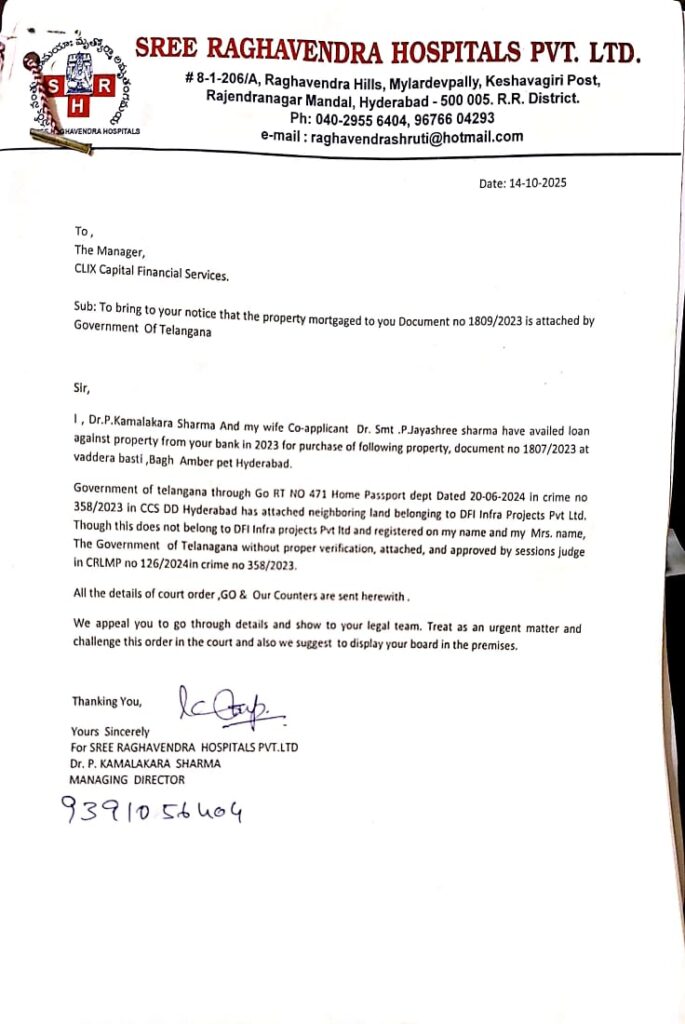

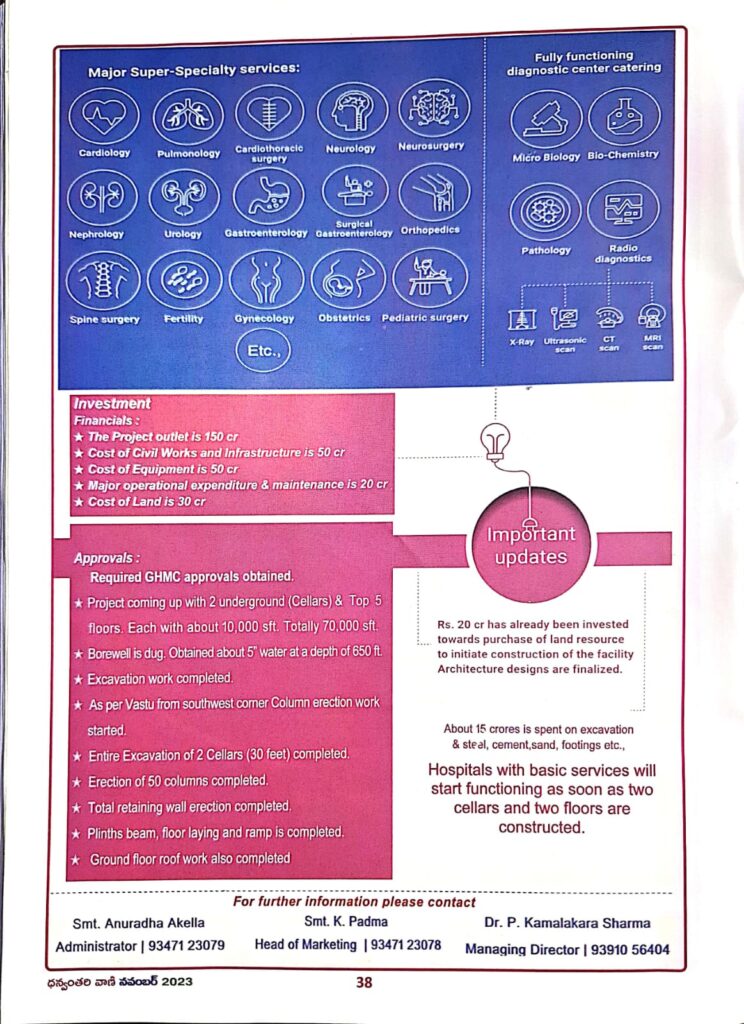
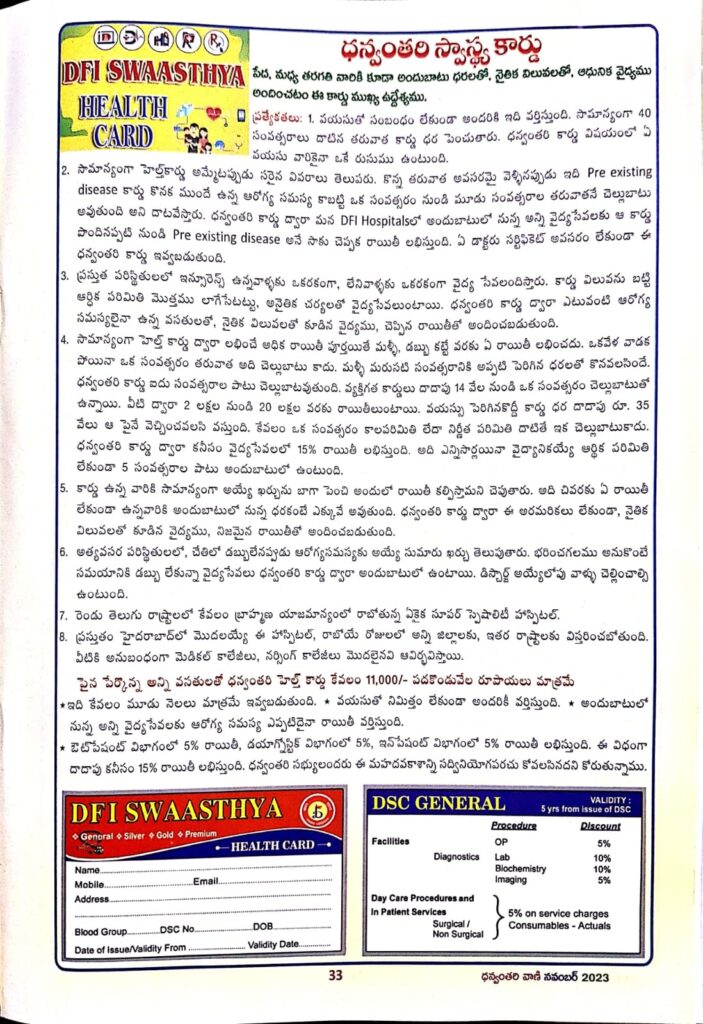
ఆకెళ్ళ అనురాధ చెబుతున్న చిలక పలుకులు
Victims Rights Protection Trust – Voice Evidence Clip
డబ్బులు కట్టించుకున్నపుడు ఒకలా, డబ్బులు తిరిగి ఇవ్వాలి అన్నపుడు మరొకలా మాట్లాడుతున్నారు.
INVESTORS’ NOTE – FROM VICTIMS’ RIGHTS PROTECTION TRUST (VRPT)
(DFI / Dhanwantari Foundation International – Present Legal Status & Action Plan)
Date: 21-11-2025
The present note is issued to all investors and affected depositors to clarify the current legal position, the findings already recorded by the competent criminal court, and the future course of action being undertaken by the Victims’ Rights Protection Trust (VRPT). This summary reflects the legal situation as on 21 November 2025.
1. Present Legal Position
The Hon’ble Metropolitan Sessions Judge-cum-Special Court for Depositors’ Cases, Nampally, Hyderabad, has already delivered a crucial order in Crl.M.P. No. 127/2024 in Crime No. 358/2023 on 29 August 2025. Through this order, the Court has confirmed and made absolute the Government’s attachment orders, including G.O.Rt.No.541 dated 5 July 2024 and G.O.Rt.No.474 dated 20 June 2024 issued under the Telangana Protection of Depositors of Financial Establishments Act, 1999 (TSPDFE Act). The Court has categorically held that DFI and its allied entities mobilised more than ₹220 crores from approximately 1,700 victims by promising plots, high returns and other benefits, and subsequently failed to honour those commitments.
The sworn affidavit of Smt. Naralapalli Swetha, IPS, Deputy Commissioner of Police, CCS-DD Hyderabad, who is the Competent Authority under the TSPDFE Act, further establishes that Crime No. 358/2023 is registered under Sections 406 and 420 read with Section 34 IPC, in addition to Sections 3 and 5 of the TSPDFE Act. She has confirmed that the Government has already attached properties acquired illegally through DFI’s schemes and that these properties now stand under the control of the Competent Authority for the benefit of depositors.
In plain terms, the Special Court has legally recognised DFI and its associated companies as a fraudulent financial establishment, has upheld the attachment of properties purchased through investors’ funds, and has opened the path for court-supervised auction and subsequent distribution of sale proceeds to the victims.
2. Nature of the Fraud – Misuse of Trust Identity
Dhanwantari Foundation International initially presented itself as a charitable trust devoted to spiritual, medical and welfare activities. Early documents such as Receipt No. 26409 dated 26 August 2008 show the DFI name and logo used strictly for bona fide membership and service-related programmes. Over the years, however, under the direct control of Dr. Pantangi Kamalakar Sharma and Smt. Patangi Jayasree Sharma, this trust identity was misused and illegally extended into commercial real estate ventures, including Agraharam projects and plot schemes at various locations such as Tirupati, Vizag and Vijayawada.
The DFI identity was also used for promoting debenture-based and bond-based investment schemes executed on ₹100 judicial bond papers through various private companies connected to the accused, including DFI Nirmaan Pvt Ltd, DFI Infra Projects Pvt Ltd, DFI I T Solutions Pvt Ltd and Dharani Sheltors Pvt Ltd. Through Dhanwantari Vani magazine, websites and “Life Membership” promotional materials, the accused converted a spiritual, trust-based membership into a captive investor base.
Notably, DFI’s own published “Aims & Objectives” contain no reference whatsoever to real estate business, plot sales, investment schemes, interest-bearing instruments or debenture mobilisation. The objects relate exclusively to education, health services, vocational training, welfare programmes, old-age homes, hostels and community development. The subsequent activities undertaken by the accused are therefore a clear and deliberate deviation from the declared charitable objectives.
These actions constitute serious offences under various provisions including Sections 406, 409, 420, 467, 468, 471, 120-B and 34 of the Indian Penal Code, along with Sections 3 to 8 of the TSPDFE Act. They also attract liability under other financial and regulatory statutes, including the BUDS Act, Companies Act and SEBI regulations.
3. Tirupati Venture – False Claims Contradicted by Their Own Documents
The accused have repeatedly made public claims that all Tirupati lands were sold and that all Tirupati investors were already paid. More recently, they have gone to the extent of claiming that no land exists and that no amounts are due to any investor. These statements are false on their face.
VRPT possesses several documents issued by their own companies which directly contradict these false claims. An Agreement dated 15 August 2020 between DFI Nirmaan Pvt Ltd and Sri Karnam Chalapathi Rao specifically refers to land located at “Sri Venkatesa Agraharam, Tirupati” and clearly establishes that DFI companies were actively selling plots and collecting money from the public. Likewise, an Advance Receipt dated 8 September 2020 issued by Dharani Sheltors Pvt Ltd for ₹1,90,000 contains a written promise to allot plots in “Dhanwantari Sri Kanaka Maha Lakshmi Agraharam” or refund the amount with 13.5% annual compensation if delivery was not completed within 123 days.
These documents bear the signatures of their own authorised officers and prove that DFI entities were engaged in plot sales, deposit collection and assured-return schemes at Tirupati. Several investors—including V. Ramana Murty (representing Late G. Raja Rajeswari), Annambhotla Vidyavathi, Vadavalli Anantha Swaroopa Rani, P. Ramakrishna, P. Kamakshi, T. Seetha Lakshmi, Dhulipala Rajyalakshmi, P.V. Ramana and Jayshree C.M.—remain unpaid to date.
Thus, the claim that “no land exists” or “no money is due” is a deliberate falsehood intended to mislead both the authorities and victims. VRPT treats this conduct as wilful fraud, criminal misrepresentation and breach of trust, over and above the offences already recognised by the Special Court.
4. Previous Notices Issued by VRPT and DFI Victims Forum
VRPT and the DFI Victims Forum have issued several formal legal and public notices to the accused. The Legal Notice dated 26 October 2025 exposed the unauthorised and fraudulent use of the DFI name, emblem and trust identity, relying upon the Special Court’s judgment and Government G.Os. The Legal Notice-cum-Plan of Action dated 25 October 2025 (Tirupati Lands) demanded full accounting and immediate settlement with investors within three days, failing which criminal and civil proceedings were to follow. The accused have not complied with these demands.
A further Serious Demand-cum-Legal Notice dated 21 October 2025 sought explanations regarding the use of approximately 1,450 judicial bond papers for illegal investment agreements executed through DFI-related entities. This notice also required cessation of all collections, plot dealings and financial solicitations. No lawful reply or settlement has been provided.
5. VRPT’s Strategy Going Forward
VRPT will now proceed by strengthening investor representation before the Special Court, ensuring that the execution of the attachment orders proceeds without interruption. An Intervention Application will be filed in the MSJ Court seeking recognition of VRPT as a party-intervenor in post-judgment proceedings. This will enable VRPT to monitor the execution process, assist the Competent Authority, and safeguard the interests of the victims.
VRPT will press for the full implementation of absolute attachment orders, appointment of a Court-appointed Receiver to safeguard properties and coordinate auctions, and issuance of directions under Section 22-A of the Registration Act to all Sub-Registrars to block further registrations and mutations relating to attached properties. The Court will be requested to approve a transparent e-auction protocol through an authorised government portal, ensuring that all sale proceeds are deposited into a Court-controlled Escrow/PD account.
After auction, VRPT will advocate for a court-approved pro-rata distribution system whereby each verified victim receives a fair share of the sale proceeds based on admitted principal amounts. VRPT will assist in compiling the victim register, collecting investor records and preparing supporting affidavits.
Additionally, VRPT will support applications to invalidate any transfer of properties effected after Government attachment orders, as such transfers are vulnerable and legally challengeable. Suspicious or benami transfers executed before attachment will also be examined and, wherever evidence indicates an intent to defeat depositors, legal action will be taken to set aside such transfers and recover sale proceeds.
If the accused approach the High Court seeking a stay or modification of the MSJ Court’s orders, VRPT will oppose such efforts. VRPT’s consistent position is that no stay should be granted on the execution of attachment and auction processes because such delays severely prejudice elderly and vulnerable victims. VRPT will assist the State and Competent Authority in presenting the full scope of fraud, victimisation and statutory violations before the High Court.
6. Investor Responsibilities at This Stage
Investors are advised to preserve and organise all documents such as receipts, debenture papers, plot agreements, bank statements and communication records with DFI or its associates. Scanned copies may be kept for safety. Investors should transmit copies of their documents to VRPT either via email at forvictimsprotection@gmail.com or via WhatsApp at 9701609689, together with basic personal details and a short description of their investment.
Investors must refrain from private settlements or partial repayments offered by the accused, as such arrangements undermine the collective legal position and may weaken claims. All investors are requested to follow only official updates issued by VRPT through authorised channels and ignore unauthorised messages or speculative forwards.
7. Closing Statement
The Victims’ Rights Protection Trust, under the leadership of Convenor Sri Kalle Nagaraja Giri Prasad Sarma and Co-Convenor Sri Mamillapally Vijay Kumar, reaffirms its commitment to pursuing full legal restitution for victim investors. VRPT will continue to work in close coordination with the Competent Authority, the Special Court and, wherever necessary, the High Court. Unity, transparency and discipline among investors will ensure that the process of attachment, auction and pro-rata distribution is completed without obstruction.
Issued for and on behalf of
Victims’ Rights Protection Trust (VRPT) – DFI Victims Forum
Sd/- Kalle Nagaraja Giri Prasad Sarma
Convenor
Sd/- Mamillapally Vijay Kumar
Co-Convenor
Email from CH S RAJAGOPAL
For Victims Rights Protection Forum & High Court Case Support
Date: Nov 22, 2025, 6:50 PM (20 hours ago)
To: me, dfivictimsforum | Attachments: Yes
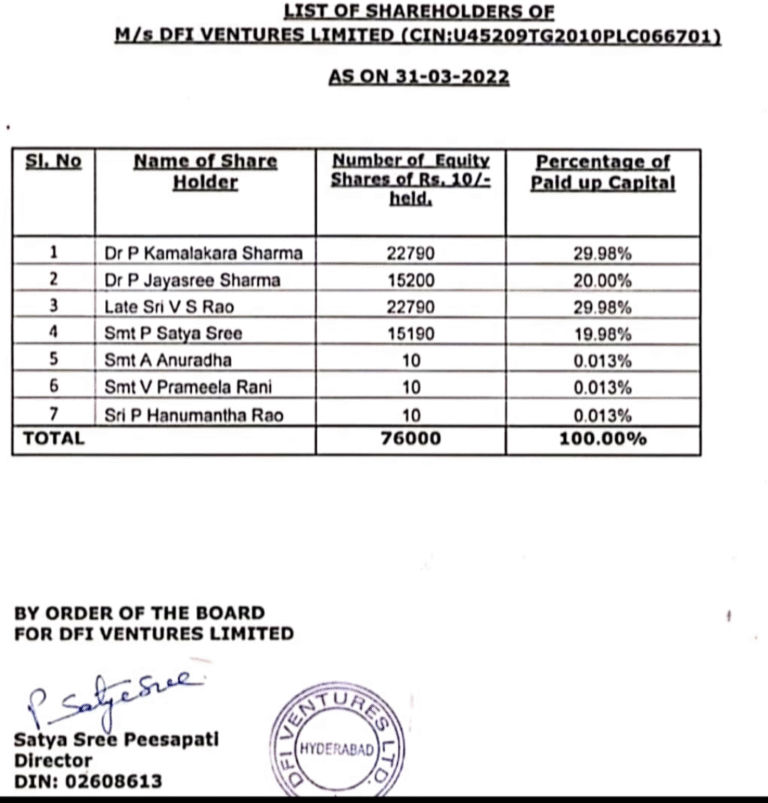
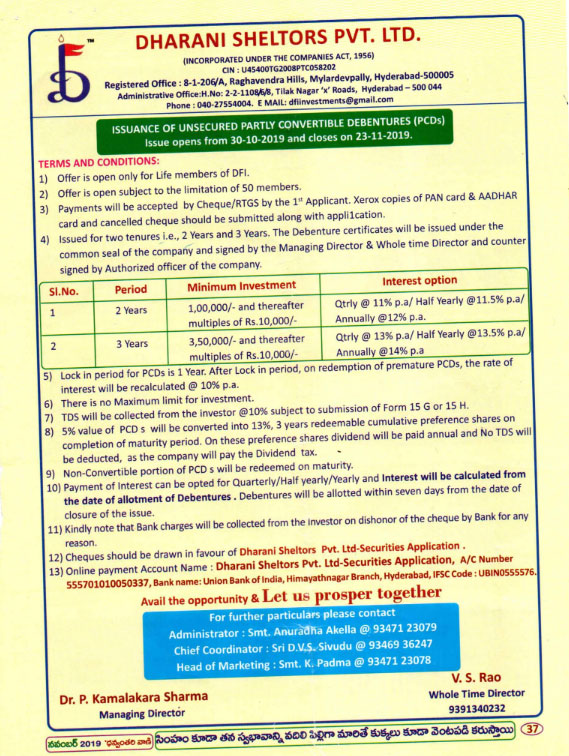
To: Me
Sairam
Had very bad, horrible and an unbearable experience with DFI especially with The main culprit and his Directors. Visited umpteen times to their office to get my invested money back since July 2021. But all my sincere and honest efforts proved to be futile. Running through severe financial problems till now. Your timely whole hearted and selfless efforts had given not only to me a ray of hope but so many unfortunate and unlucky investors like me. No words to express my sincere gratitude in this context.
Gratefully yours
TS PRAKASH RAO.
COUNTER STATEMENT / OBJECTION
S/o: Late Sri Suryanarayana Murthy
Age: 90 Years
Address: Flat No. 109, Manohar Apartments, O.U. Road, Vidyanagar
Occupation: Retired
Mobile: 9849921346
Your Lordship,
I, Chaganty Venkata Subba Rao, aged 90 years, respectfully submit that the document issued by Dharani Shelters Pvt. Ltd. regarding the issuance of so-called “Unsecured Partly Convertible Debentures (PCDs)” is itself a self-incriminating piece of evidence that clearly exposes:
- illegal collection of deposits from the public,
- unauthorized solicitation of funds in the guise of debentures,
- violation of statutory provisions governing financial establishments, and
- deliberate cheating of senior citizens and vulnerable investors.
The company has openly collected money from individuals, including myself, under the promise of:
- assured high interest returns ranging from 11% to 14%,
- conversion into cumulative preference shares, and
- guaranteed redemption with additional benefits.
These representations constitute financial inducement, falling squarely under the definition of “deposit” as per the Telangana Protection of Depositors of Financial Establishments Act, 1999, and similar statutory protections nationwide. The document explicitly states minimum investment requirements, lock-in periods, interest structure, maturity benefits, and mandatory payment through bank channels. Such structured collection is indisputably a public deposit scheme, NOT a voluntary contribution or charitable offering, as falsely argued by the accused.
Despite my repeated written and telephonic reminders over the past several years, the company:
- received my communications,
- acknowledged receipt,
- assured repayment and settlement,
yet failed to respond thereafter or return my principal or interest, causing extreme mental agony, financial hardship, and humiliation at this advanced age. Being 90 years old and a retired individual, I placed my trust in the organization believing their representations, only to be deceived.
The accused deliberately exploited senior citizens like me by offering attractive returns and misusing the name of DFI and associated entities. After collecting my investment, they stopped communication, withheld payments, and neglected all responsibilities toward investors.
This brochure issued by Dharani Shelters Pvt. Ltd.:
- clearly identifies the Managing Director and responsible officers,
- provides bank account details for deposit collection,
- restricts eligibility to “Life Members of DFI,”
- limits subscription to 50 members, proving targeted solicitation, and
- outlines binding financial obligations.
Therefore, this document destroys the false narrative being advanced before this Hon’ble Court that the amounts collected were merely “contributions” or voluntary payments. It proves commercial intent, profit-oriented fundraising, and organized mobilization of public funds in violation of financial regulations.
In view of the above, I humbly submit that:
- the accused have willfully cheated me and many other elderly investors,
- ignored repeated reminders despite acknowledgment,
- failed to repay the principal and interest promised, and
- are attempting to mislead this Hon’ble Court by seeking relief and stay orders.
I therefore pray that this Hon’ble Court:
- dismiss the stay petition,
- uphold the attachment orders,
- ensure immediate repayment and compensation to victim investors, particularly elderly individuals like myself who are suffering due to the fraudulent acts of the accused.
Submitted with utmost respect.
Written Submissions on Form 16A – DFI Ventures Limited
Your Lordship,
The document placed before this Hon’ble Court, namely the Form 16A TDS Certificate issued by DFI Ventures Limited, is a conclusive and authoritative statutory instrument that directly contradicts the appellant’s assertion that the monies collected by DFI and its allied entities were mere “contributions.” This certificate, issued under Section 203 of the Income Tax Act, 1961, unequivocally establishes that the payments made by DFI to its investors constitute interest payments arising out of deposit-based financial transactions, and not voluntary contributions or donations. The very invocation of Section 194A, under which tax was deducted at source, is legally possible only when the payment represents “interest other than interest on securities,” which presupposes the existence of a principal sum deposited with the payer. Therefore, the statutory framework itself negates the argument advanced by the appellant.
The Form 16A expressly records that DFI Ventures Limited paid amounts of ₹55,452 and ₹27,726 to the deductee, totalling ₹83,178, categorised as interest under Section 194A. The company thereafter deducted TDS of ₹8,318 and deposited the same with the Central Government. The certificate further bears the verification and certification of Dr. Pantangi Kamalakara Sharma, in his capacity as Director, affirming that the payment represents taxable interest and that tax has been duly remitted. Such a statutory declaration made to the Income Tax Department, supported by banking challans and government acknowledgement, cannot be reconciled with the narrative that the underlying transactions were mere contributions. Contributions or donations do not generate taxable interest, and no entity deducts TDS on gratuitous receipts. The very existence of TDS deduction proves a creditor–debtor relationship between the investor and DFI.
The appellant’s contention that the Depositors Act does not apply and that the learned Metropolitan Sessions Judge has misinterpreted the nature of the transactions collapses under the weight of this evidence. A “contribution” in law is voluntary, non-refundable, and without any obligation of repayment or return. In contrast, the payment reflected in this certificate is a mandatory return on a financial investment, contractually owed to the investor, and recognised by the company itself as interest. By issuing Form 16A, DFI has admitted before the sovereign tax authority that it received funds from individuals which created liability to pay periodic interest. This admission amounts to a binding acknowledgement under the law of evidence, rendering their present stance before this Hon’ble Court wholly untenable.
Furthermore, the presence of TDS deduction and government remittance demonstrates that the company operated as a financial establishment, collecting money from the public with a promise of returns, which squarely attracts the provisions of the Telangana Protection of Depositors of Financial Establishments Act, 1999. The Depositors Act is triggered the moment a financial establishment receives deposits with a promise of repayment with benefit. The documentary evidence herein satisfies every statutory ingredient. The appellant’s attempt to re-characterise these deposits as contributions is not merely misleading but constitutes an attempt to evade regulatory liability after having benefited from public funds.
This Hon’ble Court may also note that Form 16A is not an internal document created by the company, but a government-recognised statutory instrument generated through the TRACES system of the Income Tax Department. Its contents have been verified through banking channels, and the tax credit has been finalised under OLTAS matching. The State itself has accepted that the payments constitute interest. Therefore, the appellant’s argument that the learned Metropolitan Sessions Judge did not examine the nature of transactions correctly is devoid of merit. The Court below rightly concluded that the company collected deposits promising financial returns and is therefore subject to attachment proceedings under the Depositors Act.
In light of this incontrovertible evidence, any stay order would not only undermine statutory protections afforded to victims but would also embolden organised financial misconduct. The document before this Court serves as a self-proving admission by the accused that they operated a deposit-taking scheme. There exists no equitable or legal basis for granting a stay. The interests of justice, public protection, and the legislative intent of the Depositors Act demand that the appeal be dismissed and the attachment orders upheld, thereby ensuring the safeguarding of the rights of the depositors who have been systematically deceived.
Submitted with utmost respect.
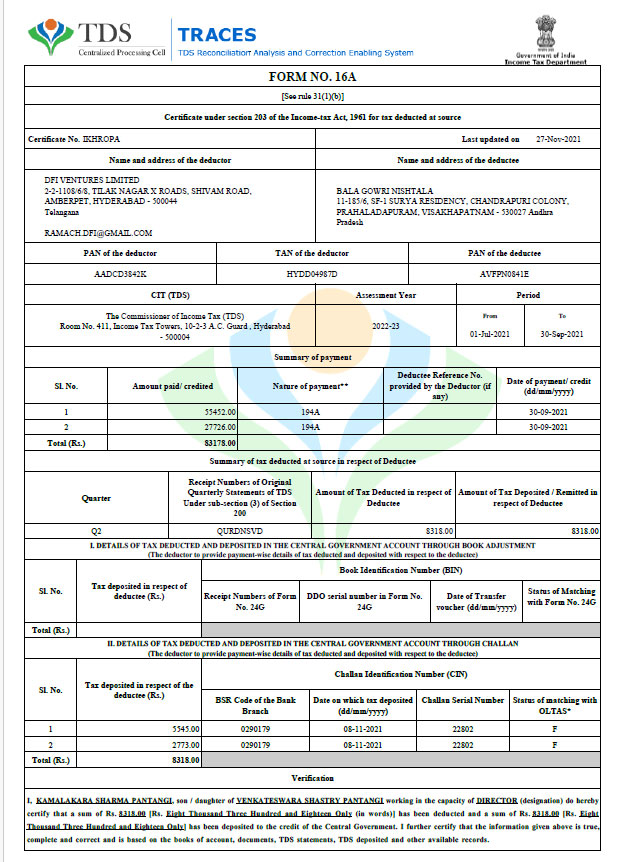
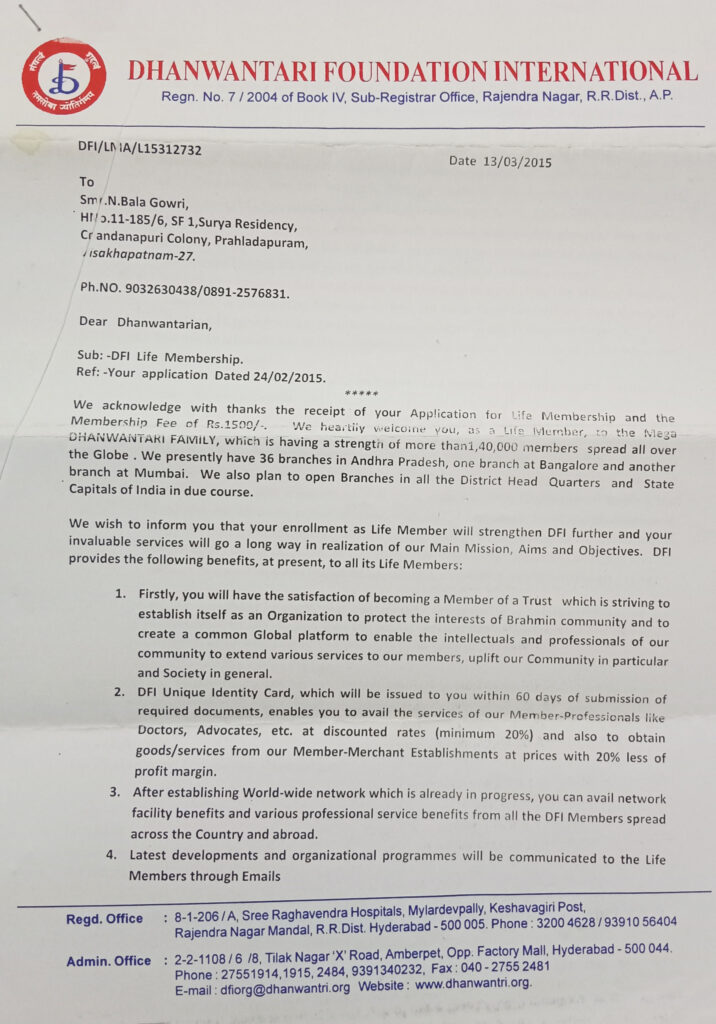
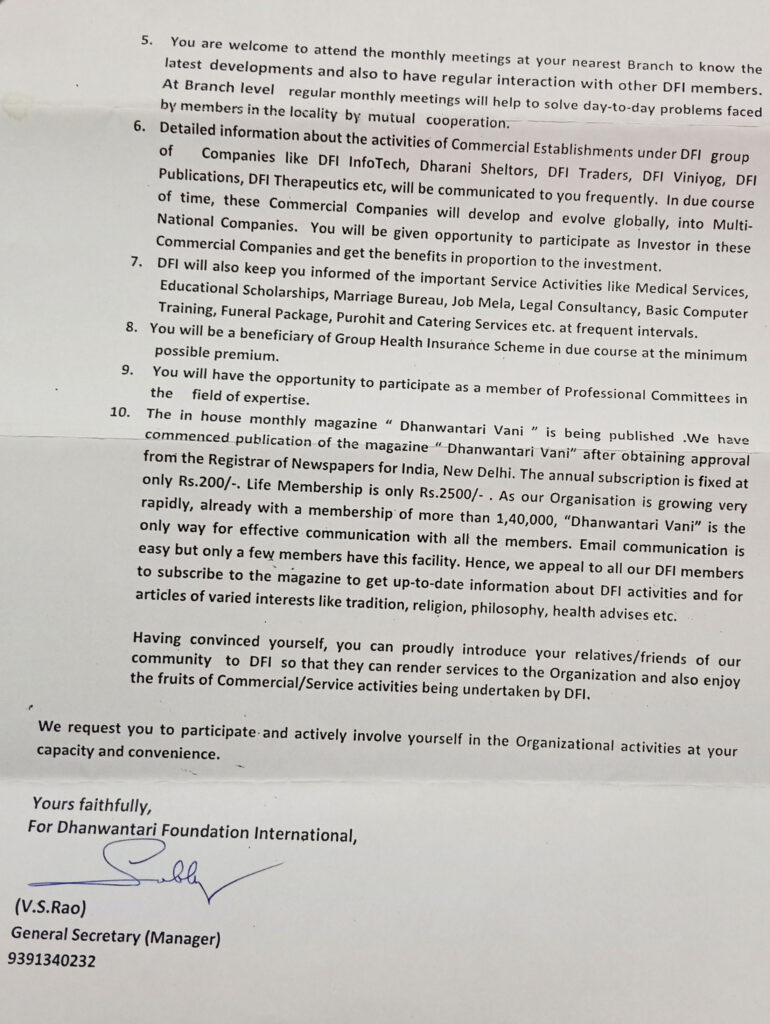
Smt/N.Bala Gowri,
H/1-11-185/6, SF 1, Surya Residency,
Cr.andanapuri Colony, Prakladapuram,
Visakhapatnam-27.
Ph.NO. 9032630438 / 0891-2576831.
Dear Dhanwatarian,
We acknowledge with thanks the receipt of your Application for Life Membership and the Membership Fee of Rs.1500/-. We heartily welcome you as a Life Member to the Mega DHANWANTARI FAMILY, which is having a strength of more than1,40,000 members spread all over the world. At present we have 36 branches in Andhra Pradesh, one branch at Bangalore and another branch at Mumbai. We also plan to open branches in all the District Head Quarters and State Capitals of India in due course.
We wish to inform you that your enrollment as Life Member will strengthen DFI further and your invaluable services will go a long way in realization of our Main Mission, Aims and Objectives. DFI provides the following benefits, at present, to all its Life Members:
Firstly, you will have the satisfaction of becoming a Member of a Trust which is striving to establish itself as an Organization to protect the interests of Brahmin community and to create a common Global platform to enable the intellectuals and professionals of our community to extend various services to our members, uplift our Community in particular and Society in general.
DFI Unique identity Card, which will be issued to you within 60 days of submission of required documents, enables you to avail the services of our Member-Professionals like Doctors, Advocates, etc. at discounted rates (minimum 20%) and also to obtain goods/services from our Member-Merchant Establishments at prices with 20% less of profit margin.
After establishing Worldwide network which is already in progress, you can avail network facility benefits and various professional service benefits from all the DFI Members spread across the Country and abroad.
Latest developments and organizational programmes will be communicated to the Life Members through Emails.
You are welcome to attend the monthly meetings at your nearest Branch to know the latest developments and also to have regular interaction with other DFI members. At Branch level regular monthly meetings will help to solve day-to-day problems faced by members in the locality by mutual cooperation.
Detailed information about the activities of Commercial Establishments under DFI group of Companies like DFI InfoTech, Dharani Sheltors, DFI Traders, DFI Viniyog, DFI Publications, DFI Therapeutics etc, will be communicated to you frequently. In due course of time, these Commercial Companies will develop and evolve globally, into Multi-National Companies. You will be given opportunity to participate as Investor in these Commercial Companies and get the benefits in proportion to the investment.
DFI will also keep you informed of the important Service Activities like Medical Services, Educational Scholarships, Marriage Bureau, Job Mela, Legal Consultancy, Basic Computer Training, Funeral Package, Purohit and Catering Services etc. at frequent intervals.
You will be a beneficiary of Group Health Insurance Scheme in due course at the minimum possible premium.
You will have the opportunity to participate as a member of Professional Committees in the field of expertise.
The in house monthly magazine “Dhanwantari Vani” is being published. We have commenced publication of the magazine–“Dhanwantari Vani” after obtaining approval from the Registrar of Newspapers for India, New Delhi. The annual subscription is fixed at only Rs.200/-. Life Membership is only Rs.2500/-. As our Organisation is growing very rapidly, already with a membership of more than 1,40,000, “Dhanwantari Vani” is the only way for effective communication with all the members. Email communication is easy but only a few members have this facility. Hence, we appeal to all our DFI members to subscribe to the magazine to get up-to-date information about DFI activities and for articles of varied interests like tradition, religion, philosophy, health advises etc.
Having convinced yourself, you can proudly introduce your relatives/friends of our community to DFI so that they can render services to the Organization and also enjoy the fruits of Commercial/Service activities being undertaken by DFI.
We request you to participate and actively involve yourself in the Organizational activities at your capacity and convenience.
For Dhanwantari Foundation International,